At a glance
- When: Tuesday, June 24, 1947, around 3 p.m. local time2.
- Where: over the Cascades, between Mount Rainier and Mount Adams, Washington State2.
- Who: Kenneth Arnold, 32, a businessman from Boise, Idaho, and private pilot, flying his single-engine CallAir2,3.
- What: nine very bright, flat objects flying in a chain from north to south, at an estimated speed of 1,200 to 1,700 mph2,8.
- US Air Force conclusion: "mirage"8. It is not the only official conclusion the case received.
The flight of June 24, 1947
At around 2 p.m., Kenneth Arnold took off from Chehalis, Washington, for Yakima2. He allowed himself an hour's detour to search the southwest slope of Mount Rainier for a large Marine Corps transport plane lost in the mountains2. Edward Ruppelt, later head of Project Blue Book, would specify that it was a C-4617.
He climbed to about 9,500 feet, the elevation of the plateau from which Rainier rises, swept the area, made a full turn over the small town of Mineral, then resumed his course east at about 9,200 feet2. The air was so smooth that he let go of the controls, and, he wrote, "the sky and air was as clear as crystal"2. Far off to his left and behind, a four-engine DC-4 was flying at 14,000 feet, about fifteen miles away2.
Nine objects between Rainier and Adams
Two or three minutes later, a flash reflected on his plane. Looking for its source, Arnold saw to the left and north of Rainier "a chain of nine peculiar looking aircraft" flying from north to south at about 9,500 feet, on a heading of about 170 degrees2. Every few seconds, two or three of them would dip or bank slightly, just enough for the sun to strike them2.
He compared them to geese: they flew "in a rather diagonal chain-like line as if they were linked together", weaving between the peaks2. What puzzled him was that he could not make out any tail on them2. He put their distance at 20 to 25 miles, seen almost at a right angle2. To judge their size he compared them with the DC-4: smaller, but with a span comparable to the distance between the airliner's outer engines2.
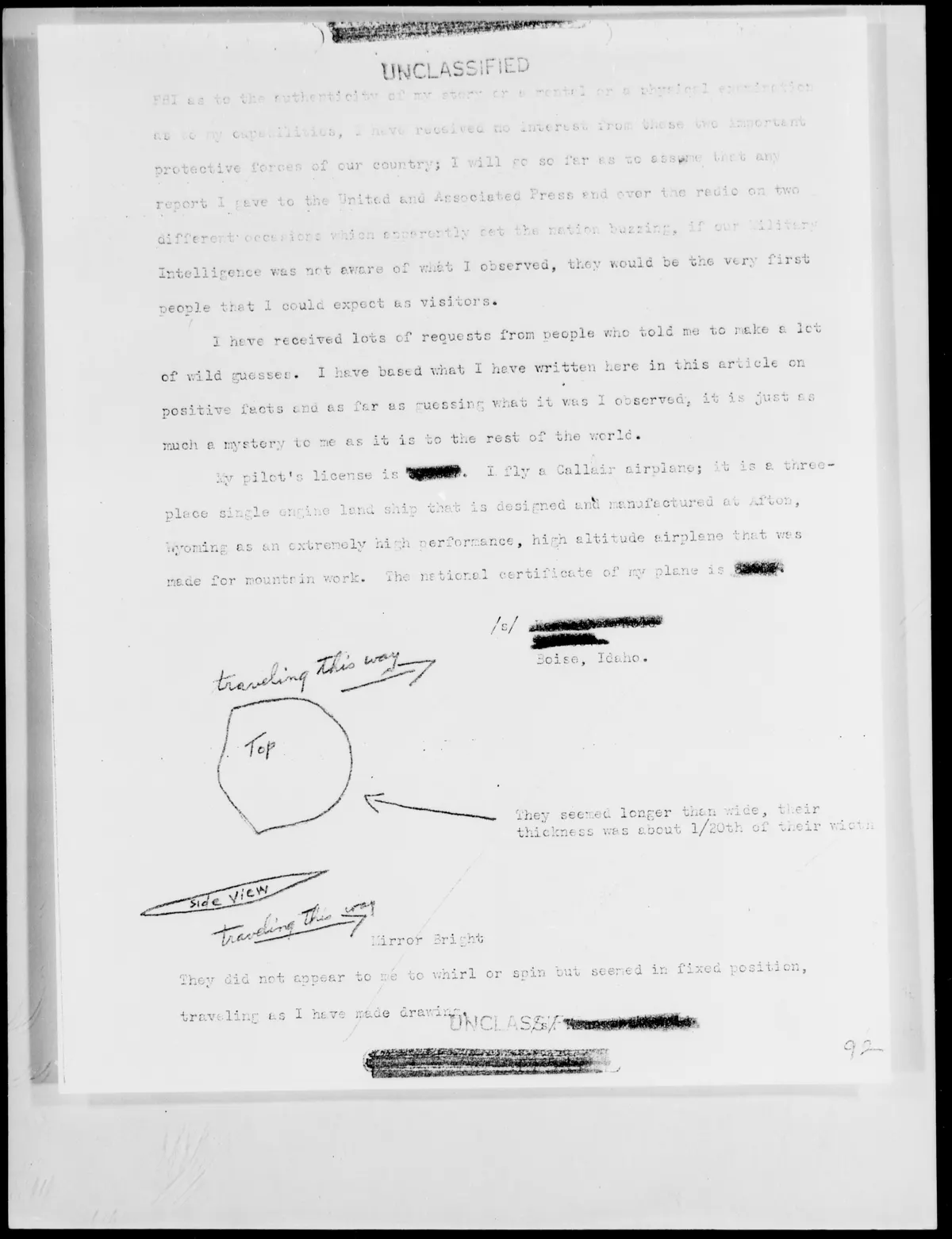
To rule out a reflection, he said he watched through the windshield, then turned the plane so he could open his window, without sunglasses2. Edge-on, the objects were "just a black thin line"; when the sun reflected off them, they looked "completely round"2. In the sketch attached to his report they are rounded at the front, cut off at the back and very thin, with the caption "They seemed longer than wide, their thickness was about 1/20th of their width", and "Mirror Bright"2.
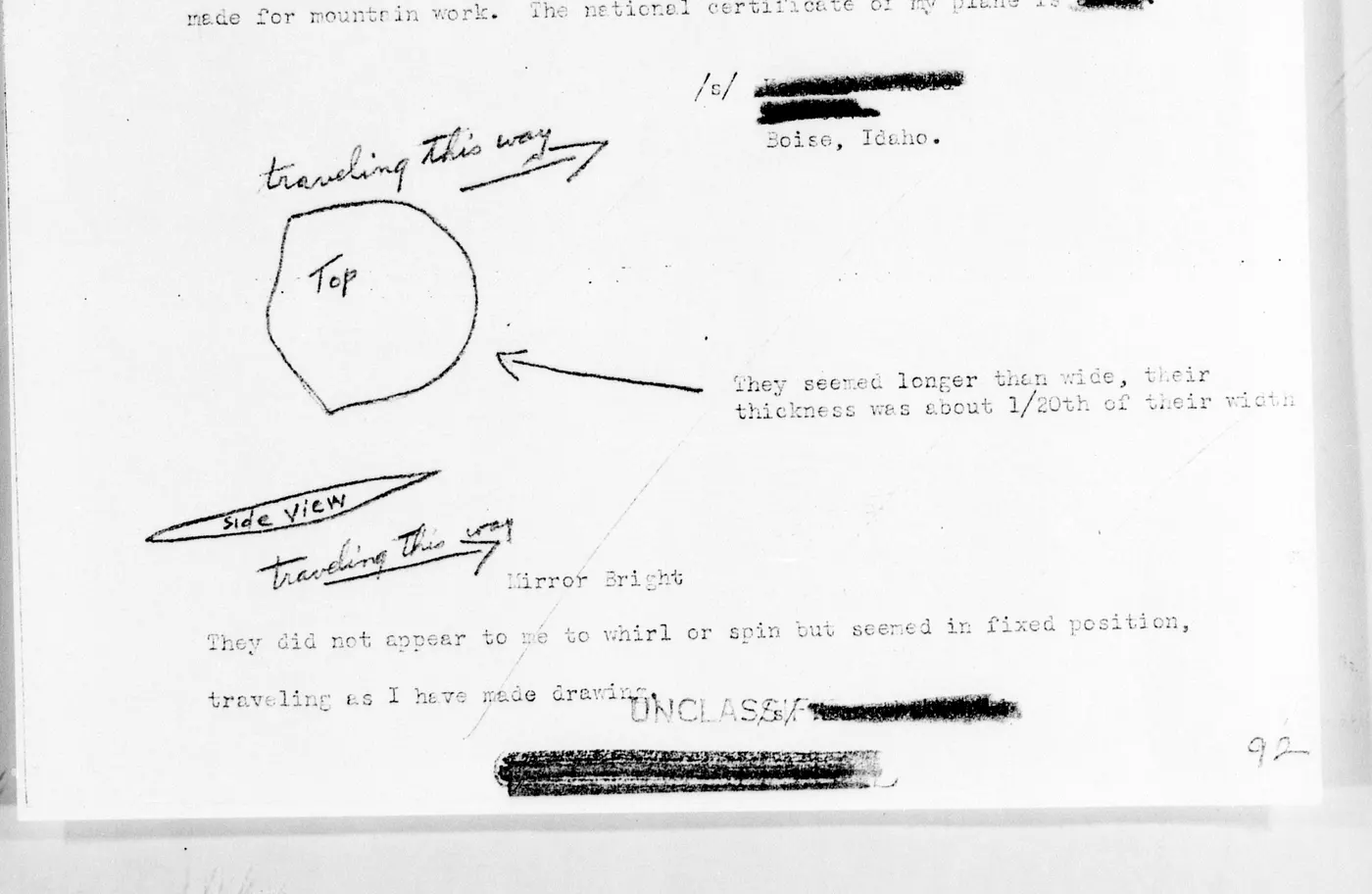
The whole sighting lasted "around two and one-half or three minutes"2. Arnold kept searching for another quarter of an hour, then headed for Yakima2.
An impossible speed for 1947
Arnold reacted like a pilot: he timed them. His dashboard clock read one minute to 3 p.m. as the first object passed the southern edge of Rainier. When the last one cleared the southern crest of Mount Adams, the second hand had covered one minute and forty-two seconds2. He also put the length of the chain at five miles at least, comparing it with a snow-covered ridge between the two peaks2.
He only measured the distance between the two mountains once he reached Pendleton2. The arithmetic is simple and dizzying. The Air Force summary used 47 miles in 102 seconds, or 1,656 mph8. The astronomer J. Allen Hynek, consulting for the military, rounded it to 1,700 mph6. Arnold himself gave the press a more cautious figure of "around 1,200 miles an hour"12,13. On the radio he added that even "giving" them three or four minutes, the speed would still exceed 800 mph12. For comparison, the speed record at the time, held by a P-80 jet fighter, was 647 mph10.
From Pendleton to the whole world: the birth of "flying saucers"
On the morning of June 25, Arnold walked into the East Oregonian, the daily paper in Pendleton, Oregon. Bill Bequette, then 28, described the scene in 1998: Nolan Skiff jotted down a few notes and wrote a short story, which Bequette squeezed into the bottom of the front page before punching an even shorter version into the Associated Press wire15. The article said Arnold had seen "nine saucer-like aircraft", "extremely bright, as if they were nickel plated"13. Arnold was quoted: "It seemed impossible… but there it is – I must believe my eyes"13.
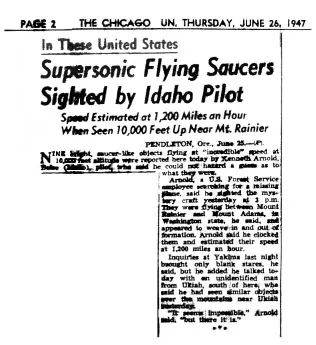
That afternoon Bequette spent two hours with Arnold at his hotel and phoned a long piece to the AP office in Portland. "Next morning almost every newspaper in the country published the story on page one," he recalled15. On June 26 the Chicago Sun ran on page 2: "Supersonic Flying Saucers Sighted by Idaho Pilot"14.
The same day, the AP carried official scepticism. An Army spokesman in Washington said that as far as he knew, "nothing flies that fast except a V-2 rocket"10. Arnold, besieged by calls, told United Press he had not "had a moment of peace" since telling his story10. On June 30 the AP wrote that Westerners were seeing "flying saucers" "almost everywhere today from Canada to Texas"10. On July 8 a headline summed up the fever: "Who Has the Saucer? 40 States Join Game"10. That same day, the FBI office in Dallas reported that a "flying disc" had been recovered near Roswell, New Mexico24.
"Flying saucer": who actually said it?
The most widespread version holds that Arnold described the objects' motion, like a saucer skipping across water, and that a reporter turned the comparison into a shape. Arnold said so himself on CBS radio in 1950: "They said that I said that they were saucer-like; I said that they flew in a saucer-like fashion"16. The Air Force summary repeats this: the description was "shortened to flying saucers by some of the newspaper men"8. The sceptic Martin Kottmeyer turned it into a thesis, "The Saucer Error": the saucer image was born of a misunderstanding and then shaped the sightings that followed20.
The 1947 documents complicate this story. In his own written report to the military in July 1947, Arnold himself wrote of "saucer like objects" and "saucer-like disks"2. On the radio on June 26, he described their shape as "something like a pie plate that was cut in half, with a sort of a convex triangle in the rear"12. As for Bill Bequette, he always denied coining the phrase: "I'm sure I didn't coin 'flying saucers'"15. The analyst Martin Shough, who reconstructed the chronology of Arnold's statements, concludes that the pure newspaper-misunderstanding thesis is partly a later reconstruction19.
The military investigates
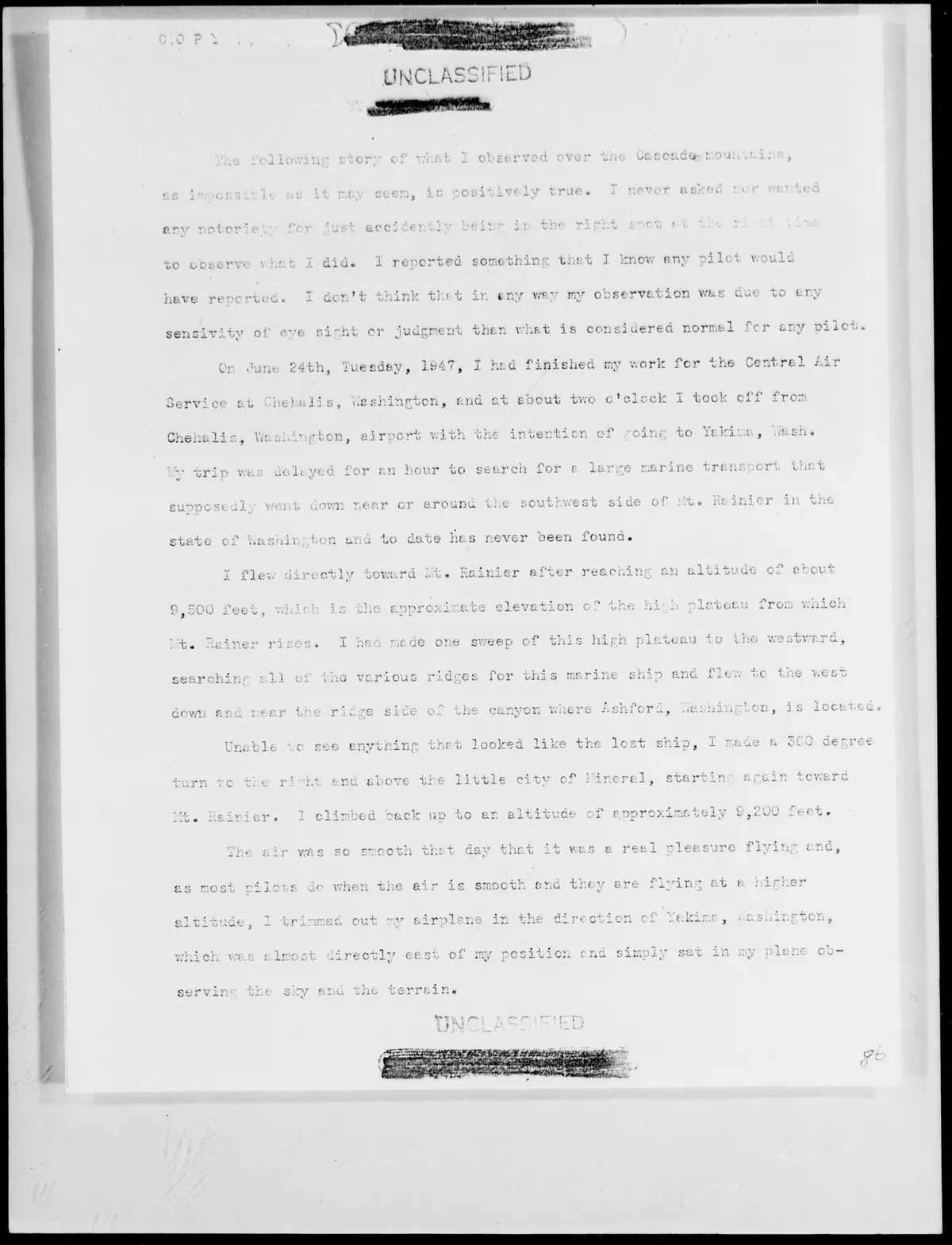
In early July, Arnold sent the Commanding General at Wright Field, Ohio, a seven-page typed report with his sketch2. It opens: "The following story of what I observed over the Cascade mountains, as impossible as it may seem, is positively true"2. On July 12 he sent a telegram authorising the military to quote, give out or reprint the report. He regretted that no one had given him an explanation, as he "felt certain they belonged to our government"4.
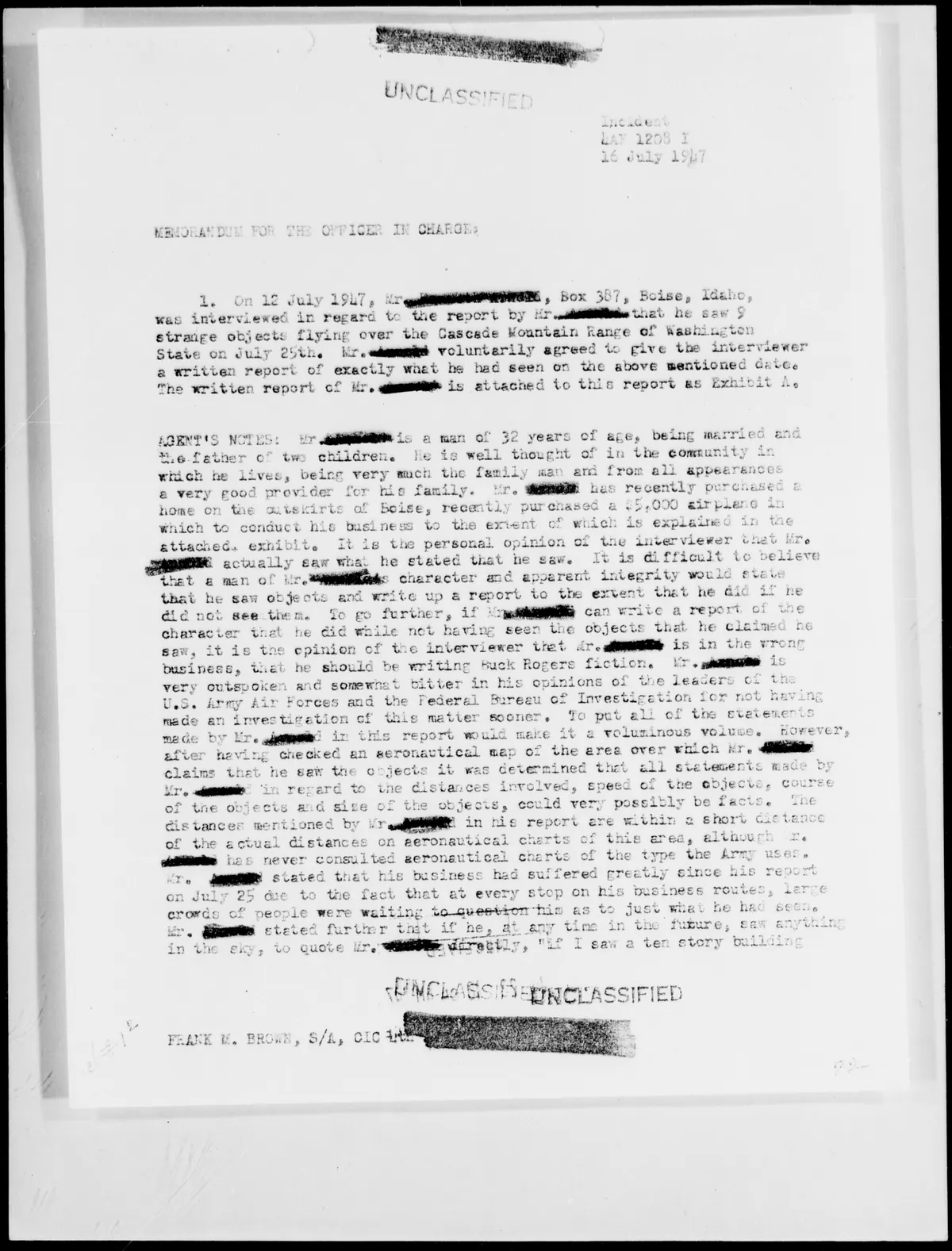
That same July 12 he was interviewed in Boise by Frank M. Brown, a special agent of the Counter Intelligence Corps, 4th Air Force3. Brown's memo, dated July 16, is unambiguous: "It is the personal opinion of the interviewer that Mr. Arnold actually saw what he stated that he saw"3. Checked against an aeronautical chart, his statements on distance, speed, heading and size "could very possibly be facts"3. Brown also noted that Arnold was "very outspoken and somewhat bitter" towards the Army Air Forces and the FBI for not investigating sooner. Arnold said that in future, "if I saw a ten story building flying through the air I would never say a word about it"3.
Brown and his colleague, Captain William L. Davidson, died a few weeks later. On August 1, 1947, their plane crashed at Kelso, Washington, on the way back from an investigation in Tacoma, the so-called Maury Island affair, in which Arnold had become involved11. Edward Ruppelt later called it a hoax: "the first, possibly the second-best, and the dirtiest hoax in the UFO history"17.
Four official conclusions for one case
The Air Force file contains several successive evaluations, and they do not agree.
| Who | When | Conclusion |
|---|---|---|
| Frank M. Brown, Counter Intelligence Corps | July 16, 1947 | Arnold saw what he describes; his figures are plausible3 |
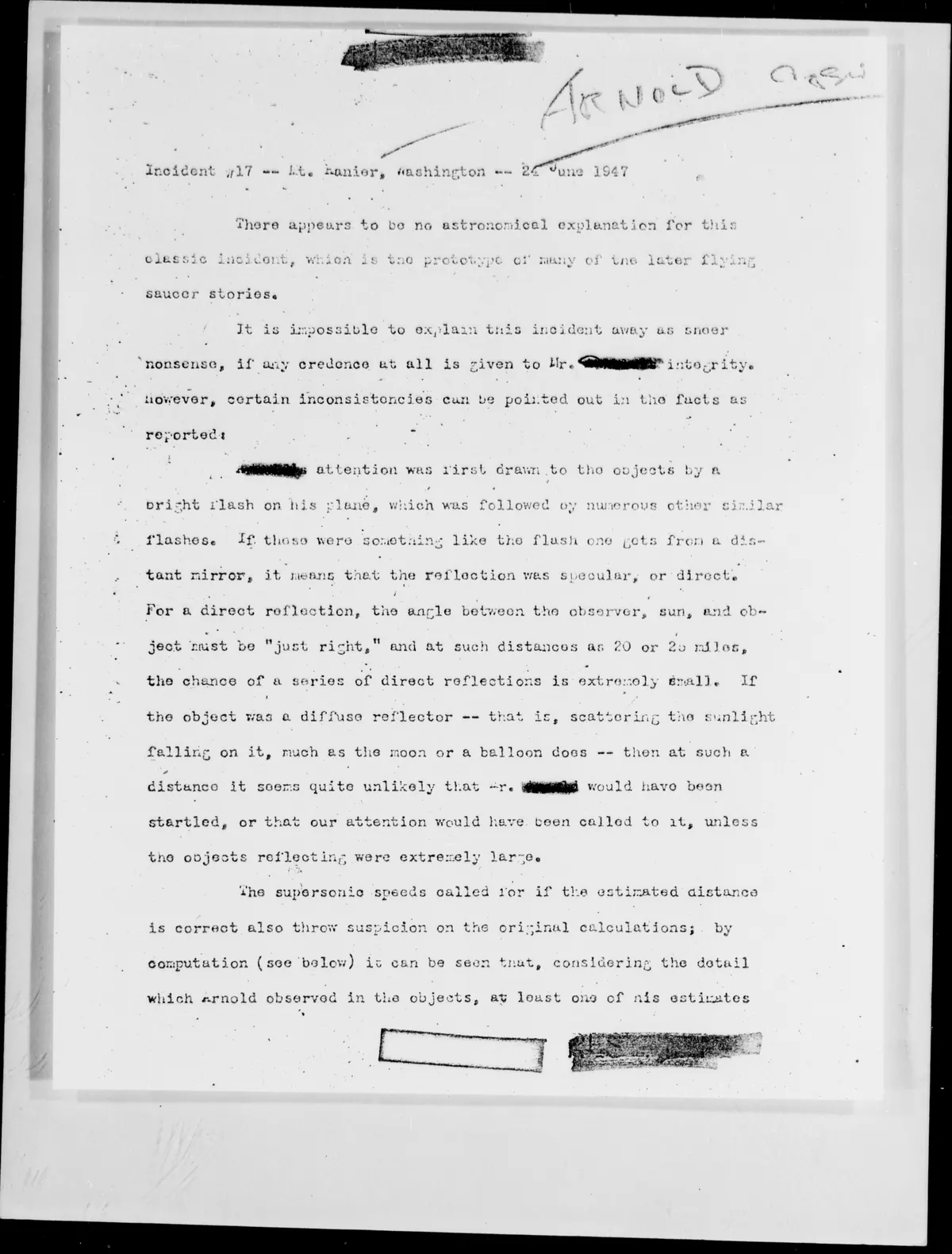
| J. Allen Hynek, astronomer, Project Sign | 1948–1949 | No astronomical explanation; the objects were probably closer and slower, possibly known aircraft6 |
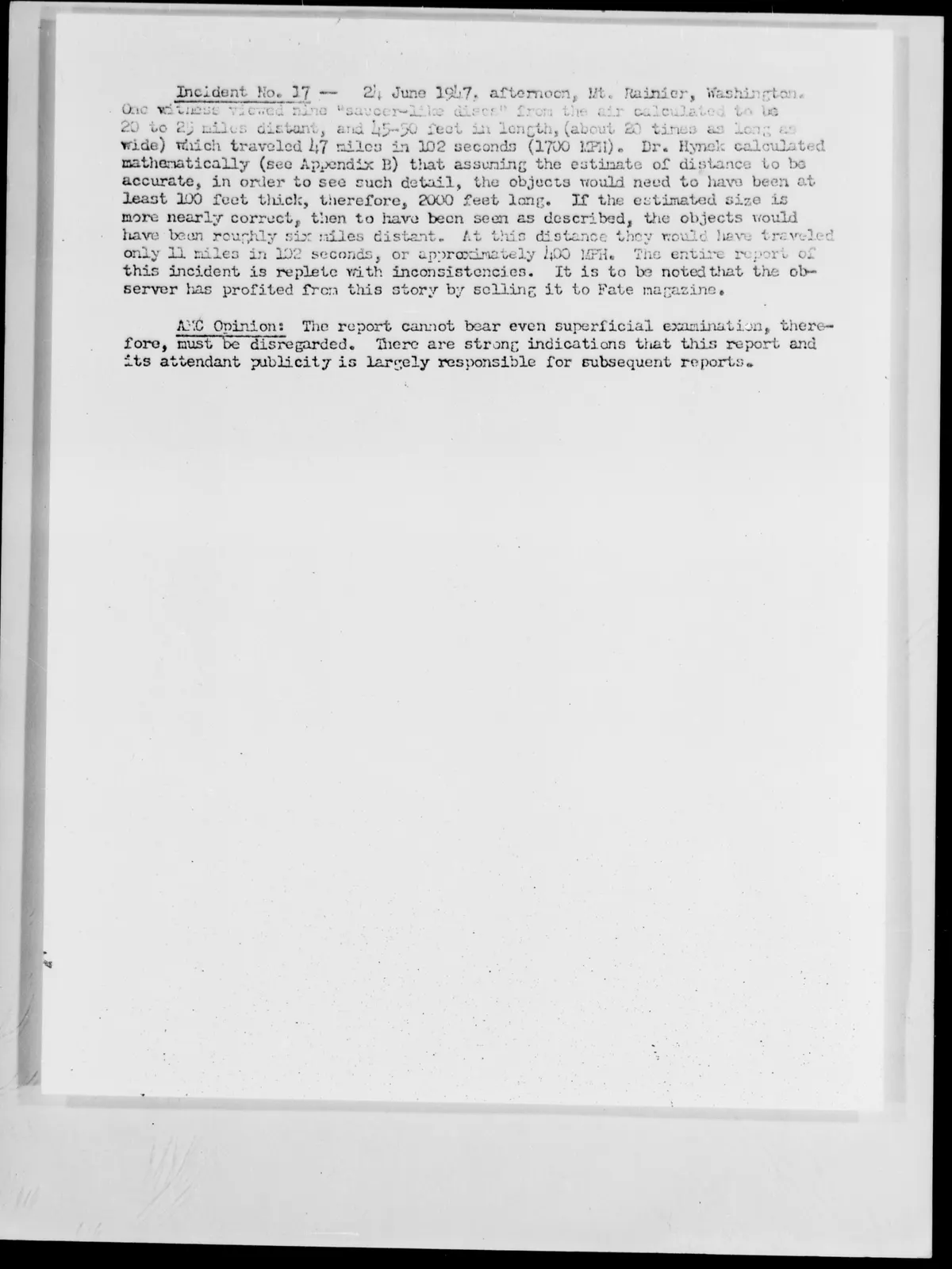
| Air Materiel Command, Project Grudge | 1949 | The report "cannot bear even superficial examination" and must be disregarded7 |
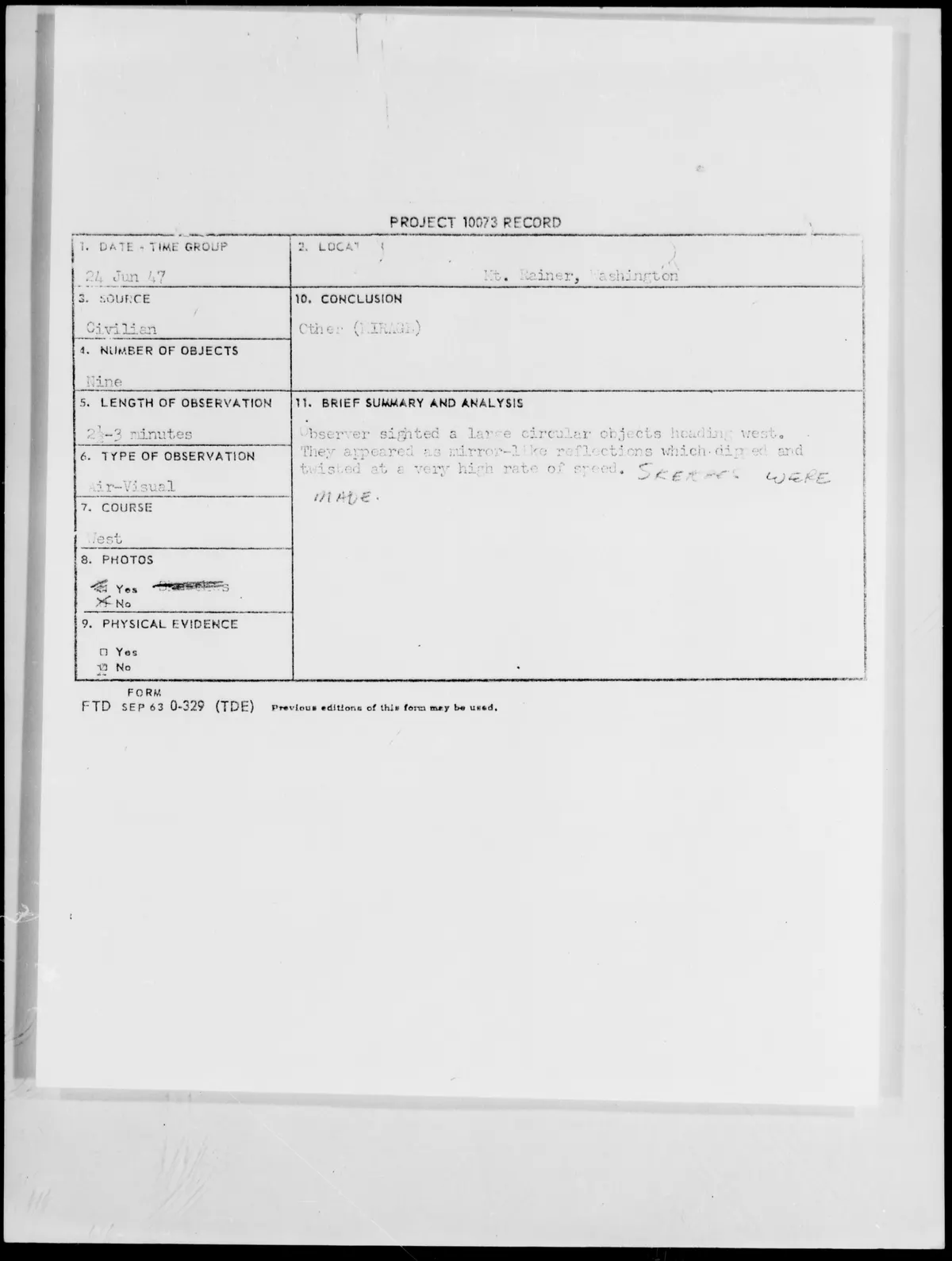
| Final Project Blue Book record | form edition of 1963 | "Other (MIRAGE)"8 |
Hynek's reasoning rests on visual acuity. At 25 miles, for Arnold to make out the objects' thickness, they would have had to be at least 100 feet thick and 2,000 feet long. And if they were only 45 to 50 feet, he could not have seen them at all. "If Arnold actually saw the objects, and if his estimate of distance is correct, that of size cannot be, and vice versa"6. Assuming a size of 400 feet at most, Hynek brought the objects to six miles and about 400 mph, a subsonic speed consistent with "some sort of known aircraft"6. Yet he also wrote that there "appears to be no astronomical explanation for this classic incident, which is the prototype of many of the later flying saucer stories", and placed the case in the category "non-astronomical, with no explanation evident"6.
The Air Materiel Command was harsher: the report is "replete with inconsistencies", and the observer "has profited from this story by selling it to Fate magazine". It added that the report and its publicity were "largely responsible" for the reports that followed7.
The final Project Blue Book record concludes "mirage". The argument: the "smooth" and "crystal clear" air Arnold described suggests very stable conditions, favourable to temperature inversions that bend light8. The same record gives the course as "West", whereas Arnold always described a north-to-south flight8,2. And Edward Ruppelt, who ran Blue Book, wrote in 1956 that the case sat in the files as just another "unknown"17.
The explanations put forward since
| Hypothesis | Put forward by | The problem |
|---|---|---|
| Jet aircraft closer than estimated | Hynek (1948–1949)6 | No pilot ever came forward; Arnold could make out the DC-4's engines at about 15 miles, which Hynek's acuity criterion would rule out18; Shough considers the criterion misapplied19 |
| Mirage | US Air Force, Project Blue Book8 | A mirage explains neither the rapid sideways motion nor the passage in front of the ridges18 |
| Mountain wave clouds | Donald Menzel and Lyle Boyd (1963)9 | Such clouds stay almost stationary21 |
| Snow blown off the peaks | Donald Menzel (1953) | Ruppelt reports the reply of a pilot who knew the area: impossible in June17 |
| Fragmenting meteors | Keay Davidson (1997), relayed by Philip Klass22 | A meteor does not go out and light up again, nor fly level for two minutes18 |
| Birds (swans or geese; pelicans) | Martin Kottmeyer (1997)21; James Easton, cited by other authors25 | Arnold himself compared them to geese, but the altitude and distance require assuming a large estimation error21 |
| Secret US aircraft | Arnold himself in July 19472,4 | The military denied it, publicly and in its exchanges with the FBI18 |
Bruce Maccabee, a physicist who favours an unexplained phenomenon, considers that no credible mundane explanation has been offered18. Martin Shough concludes after a meticulous analysis that there is "no internal reason to question Arnold's timing report", which says nothing about what the objects were19.
Where the accounts disagree
| Point | According to the sources |
|---|---|
| Take-off time | "about two o'clock" (report); "about 2:15" (radio, June 26)2,12 |
| Objects' heading | 170° (report); 160° (radio); "West" on the Blue Book record, contrary to all of Arnold's statements2,12,8 |
| Timing landmarks | Rainier and Adams (report); "Mt. Saint Helens and Mt. Adams" (radio)2,12 |
| Distance | 20 to 25 miles (report); 25 to 30 miles (AP, June 26); 6 miles at most according to Hynek2,10,6 |
| Size | smaller than the DC-4 (report); "as big as a DC-4" (AP); "45 to 50 ft" in an anonymous summary in the file, a figure that is not Arnold's2,10,5,19 |
| Speed | 1,200 mph (Arnold); 1,656 mph (US Air Force); 1,700 (Hynek); "approx 150 MPH" on a checklist, an obvious error12,8,6,5 |
| Shape | round in the sun, a thin line edge-on, cut off at the back (report); "a pie plate that was cut in half" (radio); later, one crescent-shaped object2,12,19 |
| Date | Brown's memo places the sighting on "July 25th" instead of June 243 |
The legacy
Kenneth Arnold's objects looked nothing like the round, domed saucers that took over popular imagination. Yet his sighting gave the phenomenon its name and opened the great wave of summer 1947. The military itself judged in 1949 that his account and its publicity were "largely responsible" for the reports that followed7. In his report Arnold said he was "convinced in my own mind that they were some type of airplane"2. He died in 1984, aged 6823.
The complete 61-page US Air Force file is freely available at the US National Archives1. The main documents are reproduced below.
Case documents
The original documents: shown here when they are free to reuse, otherwise available from their holder.
Sketch
Kenneth Arnold's sketch
Last page of his report to the military, July 1947: top view, side view, "Mirror Bright". Signature redacted by the Archives
Report
Arnold's report to Wright Field, page 1
"The following story of what I observed over the Cascade mountains…"
Report
Memo by Special Agent Frank M. Brown (Counter Intelligence Corps), July 16, 1947
"…actually saw what he stated that he saw"
Analysis
J. Allen Hynek's evaluation, "Incident #17"
Project Sign, reproduced in the Project Grudge report (1949)
Analysis
The Air Materiel Command opinion (Project Grudge)
"The report cannot bear even superficial examination…"
Report
The final Project Blue Book record: "Other (MIRAGE)"
"Project 10073 Record" form; note the "West" course
Contemporary press
Chicago Sun, June 26, 1947, page 2
"Supersonic Flying Saucers Sighted by Idaho Pilot" (AP story)
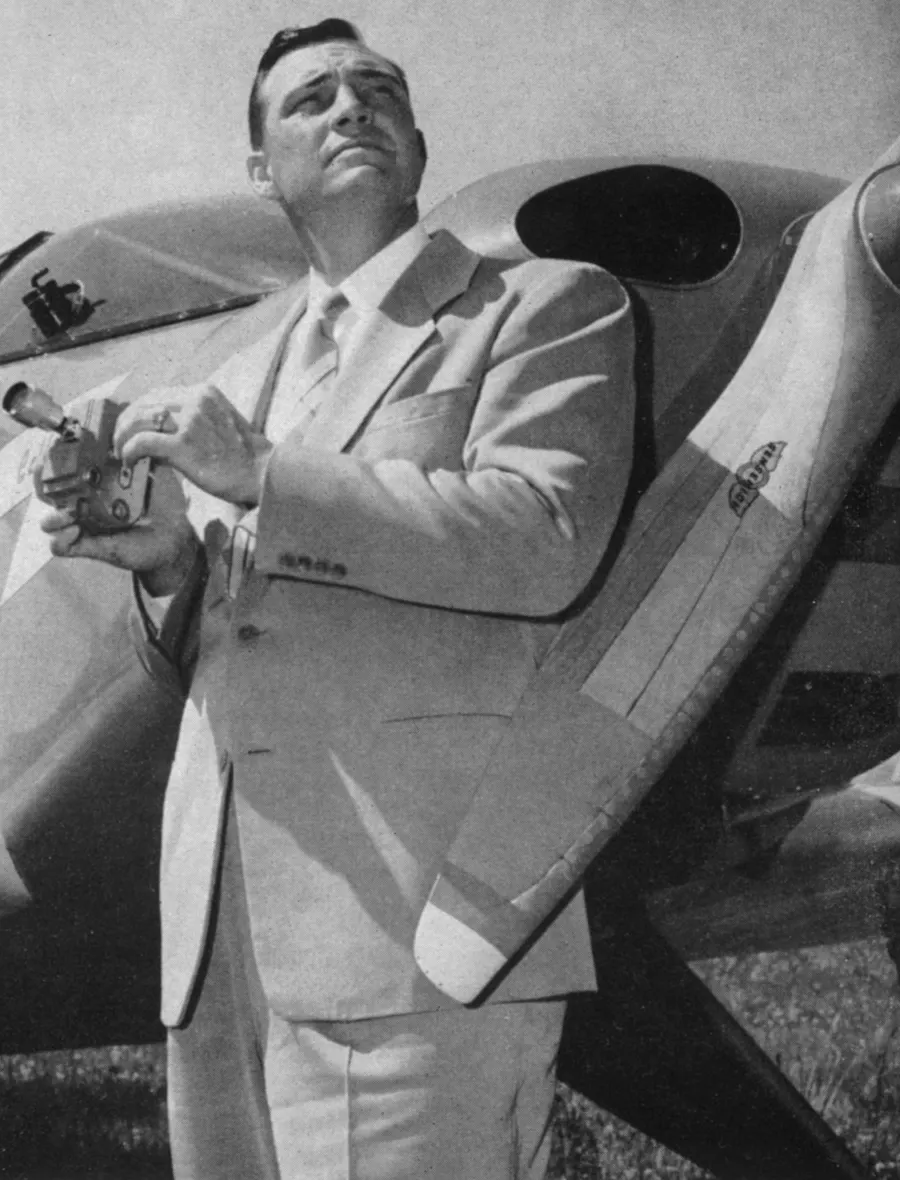
Photo
Kenneth Arnold in July 1947
Associated Press photo, July 8, 1947
Contemporary press
June–July 1947 newspaper clippings kept in the file
Hartford Times, Dayton Daily News, Montana Standard, New York Herald Tribune, Daily News (images 53 to 61 of the file)
Protected document: available from its holder, not reproduced here.
Sources
- 1.Official documentNational Archives (NARA), NAID 28929152, Project Blue Book, dossier « Mt. Rainer, Washington, June 1947 » (61 pages)
- 2.WitnessKenneth Arnold, juillet 1947, Rapport écrit de Kenneth Arnold au général commandant Wright Field, avec croquis — NARA file, images 35 to 41
- 3.Official documentFrank M. Brown, Counter Intelligence Corps, 4th Air Force, 16 juillet 1947, Memorandum for the Officer in Charge, incident 4AF 1208-I — NARA file, images 31-32
- 4.WitnessKenneth Arnold, 12 juillet 1947, Télégramme de Kenneth Arnold à Wright Field — NARA file, image 17
- 5.Official documentArmy Air Forces / Projet Sign, 1947-1948, Check-list « Unidentified Flying Objects », incident #17 — NARA file, images 18-19
- 6.Official documentJ. Allen Hynek pour le Projet Sign / Grudge, 1948-1949, Évaluation « Incident #17 », index et récapitulatif — NARA file, images 2 to 10
- 7.Official documentAir Materiel Command, 1949, Projet Grudge, résumé de l'incident n° 17 et « AMC Opinion » — NARA file, image 4
- 8.Official documentUS Air Force, Projet Blue Book, Fiche « Project 10073 Record » et résumé de l'US Air Force (conclusion mirage) — NARA file, images 1, 3, 9 and 13
- 9.AnalysisDonald Menzel et Lyle G. Boyd, 1963, The World of Flying Saucers, épreuves du chapitre « Mirage or Wave Clouds? » — copy in the NARA file, images 44 to 50
- 10.PressAssociated Press, United Press, 26 juin – 8 juillet 1947, Coupures de presse AP et UP (Hartford Times, Dayton Daily News, Montana Standard, New York Herald Tribune, Daily News) — NARA file, images 53 to 61
- 11.Official documentFBI, 1947, FBI Records: UFO (télétype de Portland sur l'accident de Kelso ; mémos de 1947)
- 12.Witnesstranscription Patrick Gross, enregistrement retrouvé par Pierre Lagrange, 26 juin 1947, Interview de Kenneth Arnold par Ted Smith, radio KWRC (Pendleton), transcription
- 13.PressNolan Skiff, Bill Bequette, 25 juin 1947, « Impossible! Maybe, But Seein' Is Believin', Says Flier », East Oregonian, p. 1 (transcription)
- 14.PressAssociated Press, 26 juin 1947, « Supersonic Flying Saucers Sighted by Idaho Pilot », Chicago Sun, p. 2
- 15.OverviewPierre Lagrange, hiver 1998, A Moment in History: An Interview with Bill Bequette, International UFO Reporter
- 16.Witnesstranscription Patrick Gross, avril 1950, Kenneth Arnold au téléphone avec Edward R. Murrow, CBS (transcription)
- 17.OverviewEdward J. Ruppelt, ancien chef du Projet Blue Book, 1956, The Report on Unidentified Flying Objects, chapitre 2 — public domain
- 18.AnalysisBruce Maccabee, 1997, révisé en 2002, Ultimate Arnold: June 24, 1947, How It All Began
- 19.AnalysisMartin Shough (NARCAP), 2010, The Singular Adventure of Mr Kenneth Arnold
- 20.AnalysisMartin Kottmeyer, mai 1993, The Saucer Error, The REALL News vol. 1 n° 4 — sceptical analysis
- 21.AnalysisMartin Kottmeyer, juin-juillet 1997, Resolving Arnold, The REALL News vol. 5 n° 6-7 — sceptical analysis
- 22.AnalysisPhilip J. Klass, juillet 1997, Skeptics UFO Newsletter n° 46 — sceptical analysis
- 23.PressPhil Wright, East Oregonian (repris par The Spokesman-Review), 25 juin 2017, Flying saucers still evasive 70 years after pilot's sighting
- 24.Official documentFBI, bureau de Dallas, 8 juillet 1947, Télétype « Flying disc, information concerning » (Roswell)
- 25.Overviewblog UFO Conjectures, avril 2007, Kenneth Arnold and the pelicans — relays James Easton's hypothesis; original publication not found
Case file written by SkyUnknown from the numbered sources below: every statement points to its own. Quotations are short and attributed; documents remain with their authors. Spotted an error, or a source we should add? Write to us