At a glance
- When: Thursday, January 8, 1981, around 5 p.m., at dusk3.
- Where: a property on the northern slope of the Nartuby valley, about 2 km east of the village of Trans-en-Provence, south of Draguignan (Var, southern France)2.
- Who: a single witness; no other came forward2. GEPAN kept him anonymous in its reports, but his name, Renato Nicolaï, has been public since 198112.
- What: a grey craft shaped like "two plates upside down, one against the other", resting on the ground for a few seconds before leaving, and a circular trace on the ground3.
- GEIPAN classification: D, "unexplained phenomenon"1.
What the witness saw
That Thursday, the witness was building a small cement shelter for a water pump behind his house. The weather station at Le Luc, 17 km away, recorded about 6.8 °C, an almost clear sky (2/8 cloud cover) and good visibility4. He told the gendarmes the next day that he heard "a slight noise, a kind of little whistle"3. Turning round, he saw a craft at the height of a large pine tree at the edge of the land, coming down towards the ground without spinning and without flames3.
He moved closer and stood against the wall of a small hut on a higher terrace. From there he saw the craft resting on the beaten-earth platform about thirty metres away3. His description was brief: the craft looked like two plates turned upside down, one against the other3. It was about 1.50 m high and the "colour of lead", with a ridge running all the way round. Underneath, two round parts stuck out by about twenty centimetres, and two other circles looked like hatches3.
Almost immediately the craft rose, still with that slight whistle, lifting a little dust. Once above the trees it left quickly towards the forest3. The witness said he saw four openings underneath, with no flame or smoke3. Right afterwards he found a circle about 2 m across on the ground, with what looked like skid marks in places3. He reported no effect on his sight or hearing3. His own first thought was a military craft, since a large training ground was nearby, and he ruled out a helicopter because of the wall2.
That evening his wife thought he was joking. The next morning he showed her the trace. She called some neighbours, who advised them to contact the gendarmerie3,2.
See the document: Gendarmerie report No. 28/1981: telex, findings, witness interview — Draguignan gendarmerie, January 9 – February 5, 1981. Telex p. 1, findings pp. 4-5, interview p. 6 (in French) (GEIPAN / CNES, droits réservés)
The trace recorded by the gendarmerie
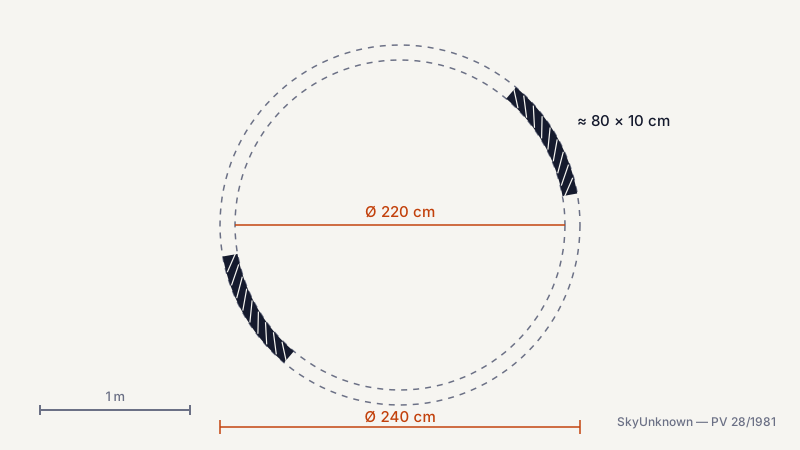
On January 9, 1981, at 11:20 a.m., a neighbour telephoned the Draguignan gendarmerie, and officers went to the site straight away3. They recorded two concentric circles, one 2.20 m and the other 2.40 m in diameter, forming a ring 10 cm wide. On this ring, two sections about 80 cm long on opposite sides bore black striations resembling skid marks3. They photographed the site, drew a 1:10 sketch, and took soil and grass samples3. They also noted that there were no power lines, railway or electric fences nearby, and that a compass showed no reaction3.
The same day, a telex was sent to GEPAN in Toulouse. It described the marks as two arcs of a circle resembling tyre skid marks3. That word, tyre, would later be at the heart of the criticism.
The investigation also checked what was in the sky that day. The army's light aviation confirmed that an Alouette II helicopter had flown over the area at 200 m above the ground at around 4:30 p.m. The army staff reported only an inert tank shell fired more than 25 km to the north, unrelated to the sighting5.
See the document: Gendarmerie photo sheet: the site and the marks (photos 1 to 7) — Report No. 28/1981, pages 7 to 11 (GEIPAN / CNES, droits réservés)
Forty days later: the GEPAN investigation
GEPAN learned of the case on Monday, January 122. Heavy rain fell on January 10 and 11, and the office chose not to travel immediately: it had the samples sent quickly to laboratories instead2. In the meantime, private groups alerted by the local press visited the site, and a private investigator started his own inquiry on January 132.
The GEPAN team arrived on February 17, 1981, forty days after the event2. It interviewed the witness again, ran a shortened reconstruction, surveyed the ground, photographed the site11 and took a new series of plant samples along a line running from the centre of the trace out to 10 m2. The trace was still visible: a lighter area in arcs of a circle, with a compacted crust about 1 cm thick2. Based on the reconstruction, the craft was about 2.50 m in diameter and 1.70 to 1.80 m high when resting on the ground2. The witness was never more than 70 m or less than about thirty metres away, and the sighting lasted 30 to 40 seconds, a few of them with the craft on the ground2.
As for the witness, GEPAN found no sign of invention or exaggeration. It noted that the changes in wording between versions came from the successive investigators rather than from him2.
The final report, Technical Note No. 16, is dated March 1, 19832.
See the document: The witness's drawings (side and underside views) and the survey of the trace — Technical Note No. 16, sketch 5 (p. 24) and sketch 7 (p. 29) (GEIPAN / CNES, droits réservés)
What the laboratories found
The soil samples went to five laboratories. Their results do not all tell the same story.
| Laboratory | What it found |
|---|---|
| CNES, microscope examination | A 6–7 mm compacted crust on very dry chalky soil, curved striations like "sanding", a flint pushed in and levelled, a dark deposit2 |
| GEPAN's usual laboratory (microprobe) | No compounds typical of a hydrocarbon engine; iron (or iron oxide) plated in striations about one micrometre thick; a deposit formed between 250 and 600 °C by its estimate6 |
| University of Toulouse (electron diffraction) | A single-crystal compound present in the ring and absent from the control soil, which heating a control sample to 1,000 °C did not reproduce8 |
| University of Metz (mass spectrometry) | Spectra similar to "certain polymers or petroleum residues"; black particles that "seem to be combustion residues"2 |
| Physical analysis laboratory, Pau | An ordinary clay-and-chalk soil, "not very significant" differences from the control, only extra zinc and phosphate7 |
The Pau laboratory went further. It suggested that the black deposit could be a black paint based on carbon black, and proposed comparing it with the paints used on the lower metal parts of heavy machinery7.
Technical Note No. 16 concluded that there had been strong mechanical pressure, "probably due to an impact", striations and erosion, heating that "did not exceed 600°", and possibly traces of iron, phosphate and zinc2. Contrary to what is often written, it gives neither a 300–600 °C range nor a mass of 4–5 tonnes for the craft. Those figures circulate on English-language websites that wrongly attribute them to the note17,2.
The plants: Michel Bounias's analyses
The most quoted part of the file comes from biochemistry. Michel Bounias, of INRA's biochemistry laboratory in Avignon-Montfavet, studied a wild alfalfa, Medicago minima, sampled at various distances from the centre of the trace10,2.
It did not start well. On January 15, 1981, Bounias wrote to GEPAN that the first gendarmerie samples had reached him dried out after four days in a paper envelope, and asked for a control sample9. More series followed: a control at 20 m on January 23, then GEPAN's series of February 172.
His results, reproduced in Technical Note No. 16, were as follows2:
- close to the trace (1.5 m), chlorophyll A fell by 33%, chlorophyll B by 28% and pheophytin by 31%;
- in young leaves, β-carotene fell by 50–57% and violaxanthin by 80%;
- the disturbances decreased with distance from the centre, following regular curves;
- there was no analogy with the effects of nuclear radiation.
Bounias suggested that a transformation of the chlorophyll "could be linked to the action of an electric-type energy field"2. In 1990 he published his work in English in the Journal of Scientific Exploration. There he argued for a radiant energy source and presented soil pH measurements intended to rule out spilled cement13.
The official conclusions
Technical Note No. 16 is cautious. The lack of any sign of invention "is not enough to certify" the account2. The soil analyses show "qualitatively" an event of some magnitude, but their interpretations "remain too diverse and vague" to confirm the testimony definitively2. The plant data confirm that a significant event took place at that spot, but "whether this matches the description given by the witness remains to be seen"2.
In 1990, Jean-Jacques Velasco of CNES published an English translation of the note. It contains a shift in meaning: "qualitatively" became "in quantitative fashion", which strengthens the conclusion12,2. In 1997, before a panel of scientists meeting at Pocantico (New York), Velasco put forward an order of magnitude of about 700 kg for the craft if it was stationary. The panel stressed the weakness of a single witness and suggested testing mundane causes, such as a metal water barrel or a loaded wheeled object14.
GEIPAN's current case record, updated in 2021, keeps the D classification: an important, unusual phenomenon occurred that day, and the investigation could not determine its origin1.
The critics and mundane explanations
The case has its detractors too, and their arguments partly rely on the same documents.
- A tyre mark. The gendarmerie's first report spoke of tyre skid marks3. Éric Maillot, of the Cercle zététique (a French sceptics' group), points out that the word disappears from the Technical Note. He adds that carbon black, zinc and phosphates are common tyre components, and says he reproduced the microscopic look of the striations by spinning a wheel on clay-and-chalk soil16.
- A cement mixer or building machinery. Michel Figuet, of the SERPAN group, reports that an outbuilding had been built about twenty metres away the month before15,16. The Pau laboratory had itself mentioned the paint used on heavy machinery7.
- A flawed method. In Les OVNI du CNES (2007), Didier Rossoni, Éric Maillot and Éric Déguillaume accuse GEPAN of breaking its own rules. They cite the visit on day 40 to a site already trampled, samples taken along a single line, and a complete "ring" that would be an extrapolation, since only the two arcs are hatched on the gendarmerie sketch15. In their words, the often-repeated image of a single, perfect circular trace is "entirely false"15.
- A hoax that got out of hand. This is Michel Monnerie's hypothesis (1984), reported by the sceptical authors: a joke played on the witness's wife that became impossible to retract once the gendarmerie was involved15,16. The same authors quote television remarks by the witness and a reputation as a prankster15,16. These are critics' allegations that we have not been able to verify.
Bounias responded on the cement question with his pH measurements, which varied neither with distance nor over time13. The sceptics consider this experiment poorly described: the proportion of cement is not given and the protocol is non-standard15,16.
Where the accounts disagree
As is often the case, the documents contradict each other on points of detail. Some of them matter.
| Point | According to the sources |
|---|---|
| Landed or hovering? | The January 9 telex says the craft came down "to about 1 metre from the ground"; the interview the same day says it was "resting on the ground"3 |
| Dust | "no dust raised" in the telex, "a little dust" in the interview3 |
| Noise | "silently" in the report summary, a "slight whistle" in the interview, a "fairly strong gust of wind" according to GEPAN3,2 |
| Distance | 50 m (telex), about thirty metres (interview), between 30 and 70 m (GEPAN)3,2 |
| Size | 3 m in diameter (telex), 1.50 m high (interview), 2.50 m by 1.70–1.80 m (GEPAN); the Technical Note itself notes very different proportions from one drawing to another3,2 |
| Duration | about a minute (telex), 30 to 40 seconds (GEPAN)3,2 |
| Shape of the trace | two circles and two 80 cm arcs (gendarmerie), a circle of about 2 m (witness), an area 2.5 to 3 m across (Bounias, 1990)3,13 |
What remains
More than forty years on, two readings still clash. For GEIPAN, an unusual physical event really did happen on that terrace, and nothing has established its origin1. For the sceptics, a lone witness, shifting versions and a trace consistent with a vehicle are enough to explain the case15,16.
The established facts are few: a single witness, a trace recorded by the gendarmerie the next day, and laboratory results that do not converge. Nobody has shown that the trace and the account belong to the same event, or that they do not. The original documents are available on the GEIPAN website, and the list below lets you read them for yourself.
Case documents
The original documents: shown here when they are free to reuse, otherwise available from their holder.
Report
Gendarmerie report No. 28/1981: telex, findings, witness interview
Draguignan gendarmerie, January 9 – February 5, 1981. Telex p. 1, findings pp. 4-5, interview p. 6 (in French)
Protected document: available from its holder, not reproduced here.
Photo
Gendarmerie photo sheet: the site and the marks (photos 1 to 7)
Report No. 28/1981, pages 7 to 11
Protected document: available from its holder, not reproduced here.
Sketch
The witness's drawings (side and underside views) and the survey of the trace
Technical Note No. 16, sketch 5 (p. 24) and sketch 7 (p. 29)
Protected document: available from its holder, not reproduced here.
Report
GEPAN Technical Note No. 16, "Investigation 81/01 – Analysis of a trace" (1983)
67 pages: investigation, soil and plant analyses, conclusions (in French)
Protected document: available from its holder, not reproduced here.
Analysis
Michel Bounias's INRA report on the wild alfalfa (1981)
"Biochemical disturbances observed in connection with the appearance of an unidentified aerospace phenomenon" (in French)
Protected document: available from its holder, not reproduced here.
Analysis
Pau laboratory analysis (October 23, 1981): the paint hypothesis
Protected document: available from its holder, not reproduced here.
Correspondence
Army letters: the Alouette II helicopter and the tank firing
Protected document: available from its holder, not reproduced here.
Correspondence
French Met Office letter on the weather of January 8, 1981
Protected document: available from its holder, not reproduced here.
Sources
- 1.Official documentGEIPAN / CNES, mise à jour 2021, Fiche du cas Trans-en-Provence (83) 08.01.1981, n° 1981-01-00849
- 2.Official documentGEPAN / CNES, 1er mars 1983, Note technique n° 16, « Enquête 81/01 – Analyse d'une trace »
- 3.Official documentGendarmerie nationale, brigade de Draguignan, 9 janvier – 5 février 1981, Procès-verbal n° 28/1981 (télex, constatations, audition, photos)
- 4.Official documentMétéorologie nationale, bureau climatologique Sud-Est, 27 juillet 1981, Conditions météorologiques le 8 janvier 1981 vers 17 h
- 5.Official documentMinistère de la Défense, 1981, Courriers de l'ALAT et de l'état-major de l'armée de terre au CNES
- 6.Official documentLaboratoire d'analyse du GEPAN, 1981, Résultats des analyses des échantillons de sol (microsonde)
- 7.Official documentLaboratoire d'analyses physiques, Pau, 23 octobre 1981, Analyse par spectrométrie de masse à étincelles
- 8.Official documentUniversité de Toulouse, 12 octobre 1981, Examens en diffraction électronique
- 9.Official documentINRA Avignon-Montfavet, janvier 1981, Courriers de l'INRA, dont la lettre de Michel Bounias du 15 janvier 1981
- 10.AnalysisMichel Bounias, INRA, 1981, Perturbations biochimiques observées en relation avec l'apparition d'un phénomène aérospatial non identifié chez une luzerne sauvage
- 11.Official documentGEPAN / CNES, 1981, Photos du site
- 12.AnalysisJean-Jacques Velasco, Journal of Scientific Exploration 4(1), 1990, Report on the Analysis of Anomalous Physical Traces: The 1981 Trans-en-Provence UFO Case — abridged translation of Technical Note No. 16
- 13.AnalysisMichel Bounias, Journal of Scientific Exploration 4(1), 1990, Biochemical Traumatology as a Potent Tool for Identifying Actual Stresses Elicited by Unidentified Sources
- 14.AnalysisPeter A. Sturrock et al., Journal of Scientific Exploration 12(2), 1998, Physical Evidence Related to UFO Reports: The Proceedings of a Workshop Held at the Pocantico Conference Center — pp. 202-205
- 15.AnalysisDidier Rossoni, Éric Maillot, Éric Déguillaume, 2007, Les OVNI du CNES, chapitre 13 « Trans-en-Provence (1981) » — sceptical analysis, in French
- 16.AnalysisÉric Maillot, Cercle zététique, vers 1997-2001, Trans en Provence : le mythe de l'OVNI scientifique — sceptical analysis, in French, archived page
- 17.OverviewBernard Haisch, ufoskeptic.org, UFO Case 4: The Trans-en-Provence Case — cited here for its incorrect figures
Case file written by SkyUnknown from the numbered sources below: every statement points to its own. Quotations are short and attributed; documents remain with their authors. Spotted an error, or a source we should add? Write to us