At a glance
- When: the night of Tuesday, February 24 to Wednesday, February 25, 1942. The guns fired between 3:12 and 4:15 a.m. Pacific time2.
- Where: the sky over Los Angeles, from Santa Monica to Long Beach, California1.
- What: targets reported as planes, balloons or an airship, at which the 37th Coast Artillery Brigade fired 1,430 shells2,9.
- Toll: no bombs, no aircraft shot down, no military casualties. Five civilians died: three in road accidents during the blackout, two of heart attacks2,10.
- Official explanation: most likely a weather balloon released at about 1 a.m. by an anti-aircraft regiment, then war nerves1,4.
- In the atlas: the event predates all our sources, so it has no case page.
A coast on edge
Since the attack on Pearl Harbor on December 7, 1941, the US West Coast had been expecting to be hit. Alerts and blackouts had become routine1. On the evening of Monday, February 23, 1942, while President Roosevelt was giving a radio fireside chat, the Japanese submarine I-17 surfaced off Ellwood, north of Santa Barbara. It fired thirteen shells at oil installations, doing little damage1. Militarily the attack achieved nothing, but it stole the headlines from the president's speech.
On the 24th, naval intelligence warned of a possible attack within ten hours. That evening, flares and blinking lights were reported near defence plants. A first alert, called at 7:18 p.m., was lifted at 10:23 p.m.1.
The night of February 25
In the early hours, radar picked up a target 120 miles west of Los Angeles. What followed, according to the official history of the US Army Air Forces1:
- 2:15 a.m.: anti-aircraft batteries were alerted, then cleared to fire a few minutes later. The fighters stayed on the ground: commanders preferred to wait until they knew how big the attack was.
- 2:21 a.m.: a full blackout was ordered. Sirens woke the city at 2:255,6.
- The target from the sea had vanished from the screens, but the information centre was flooded with reports of "enemy planes".
- 2:43 a.m.: planes were reported near Long Beach. A coast artillery colonel saw "about 25 planes at 12,000 feet" over the city.
- 3:06 a.m.: a balloon carrying a red flare was seen over Santa Monica. Four batteries opened fire, and "the air over Los Angeles erupted like a volcano".
"From this point on reports were hopelessly at variance," the Air Force historians write. For three hours there were reports of "swarms" of planes or balloons, from one to several hundred, at every possible altitude and speed1. Shell bursts caught in the searchlights were themselves taken for planes1. Rumours said four enemy aircraft had been shot down, one of them crashing in flames at a Hollywood intersection1. The all-clear sounded at 7:19 a.m.6.
In the morning, residents found the damage done by shell fragments: a garage door ripped off, shattered windows, a bed torn apart minutes after the women sleeping in it had got up, an unexploded shell in a driveway6. A Long Beach police sergeant, E. Larson, 59, was killed in a crash on his way to his post. Henry B. Ayers, 63, a State Guardsman, died of a heart attack at the wheel of an ammunition truck6. The Los Angeles Times counted five dead, none of them killed by the gunfire itself10.
The front pages of February 25
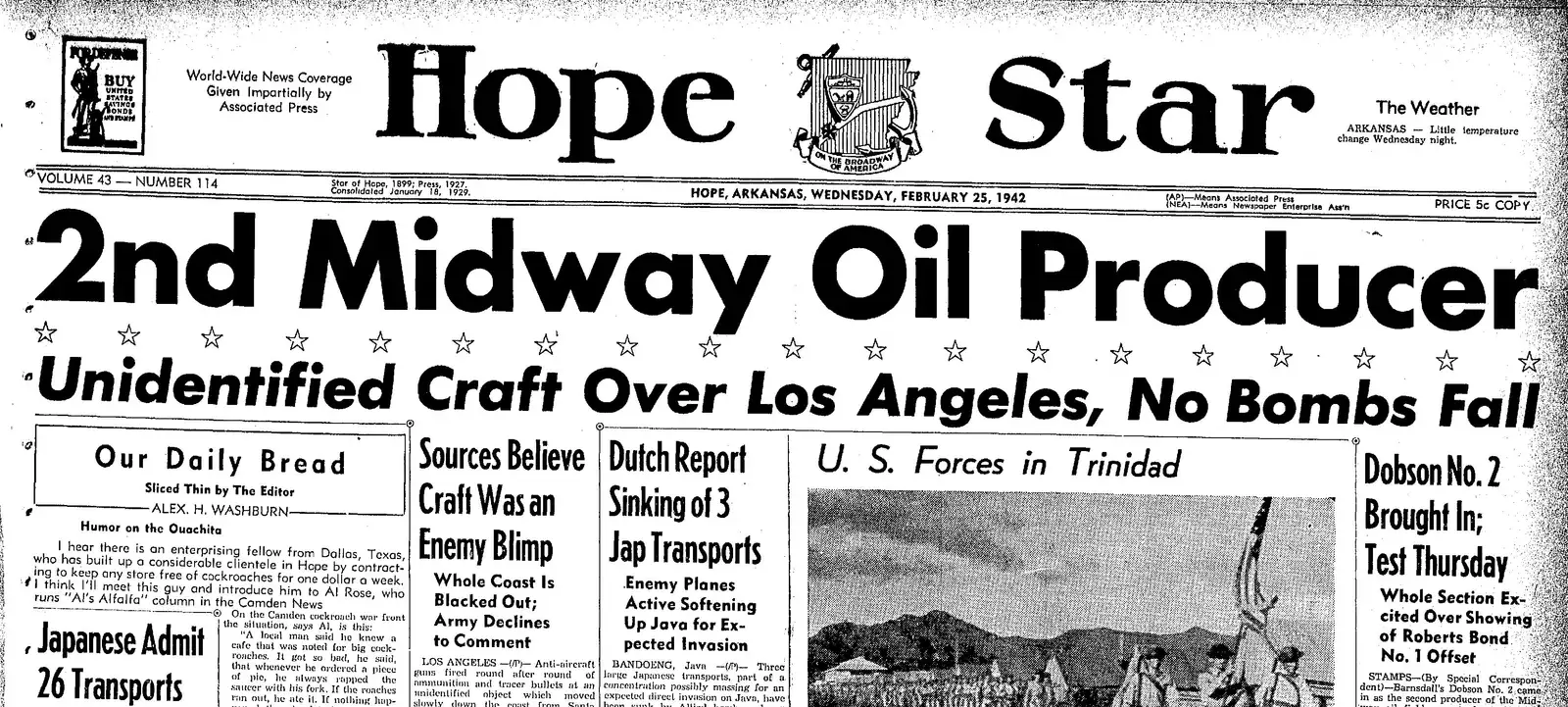
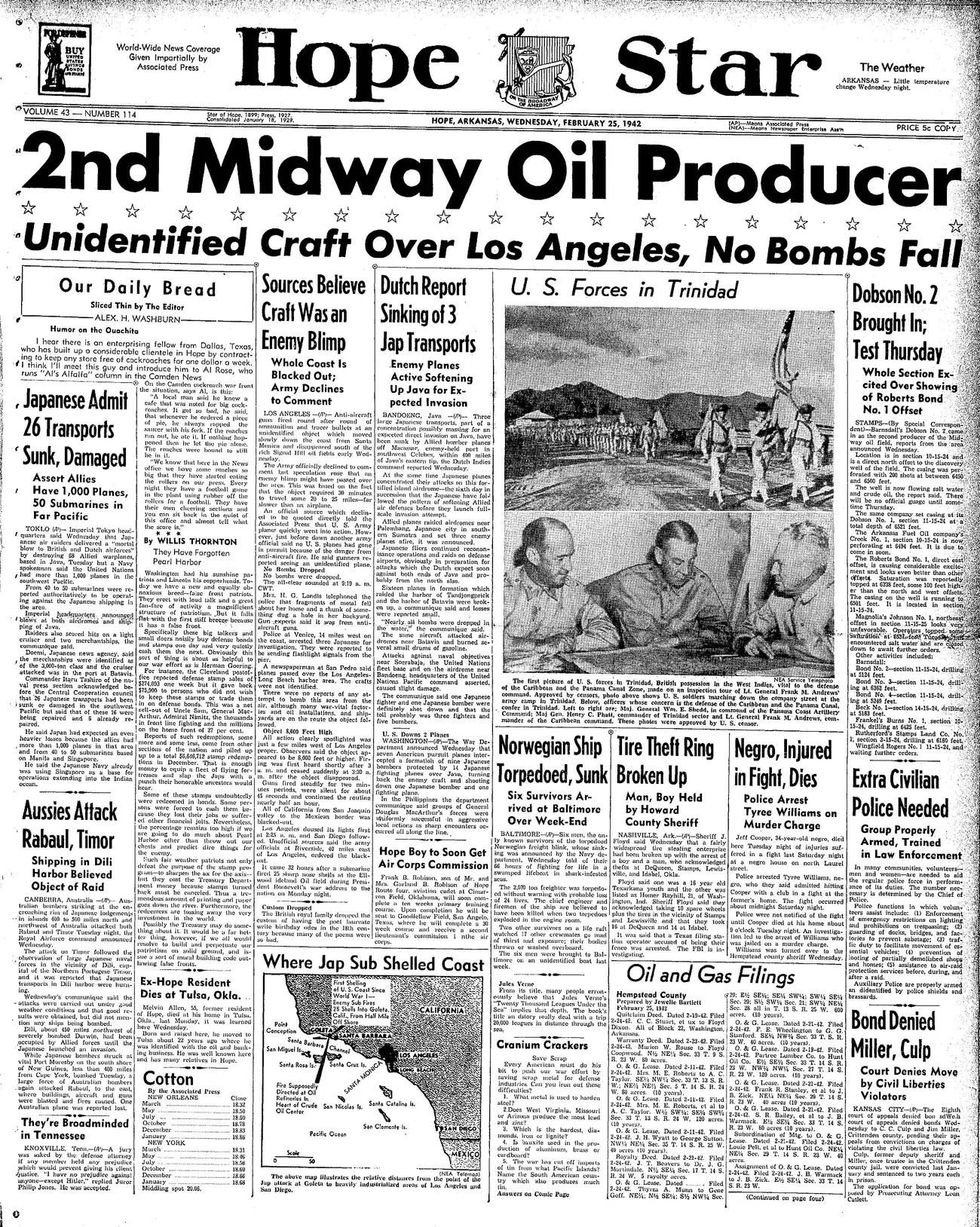
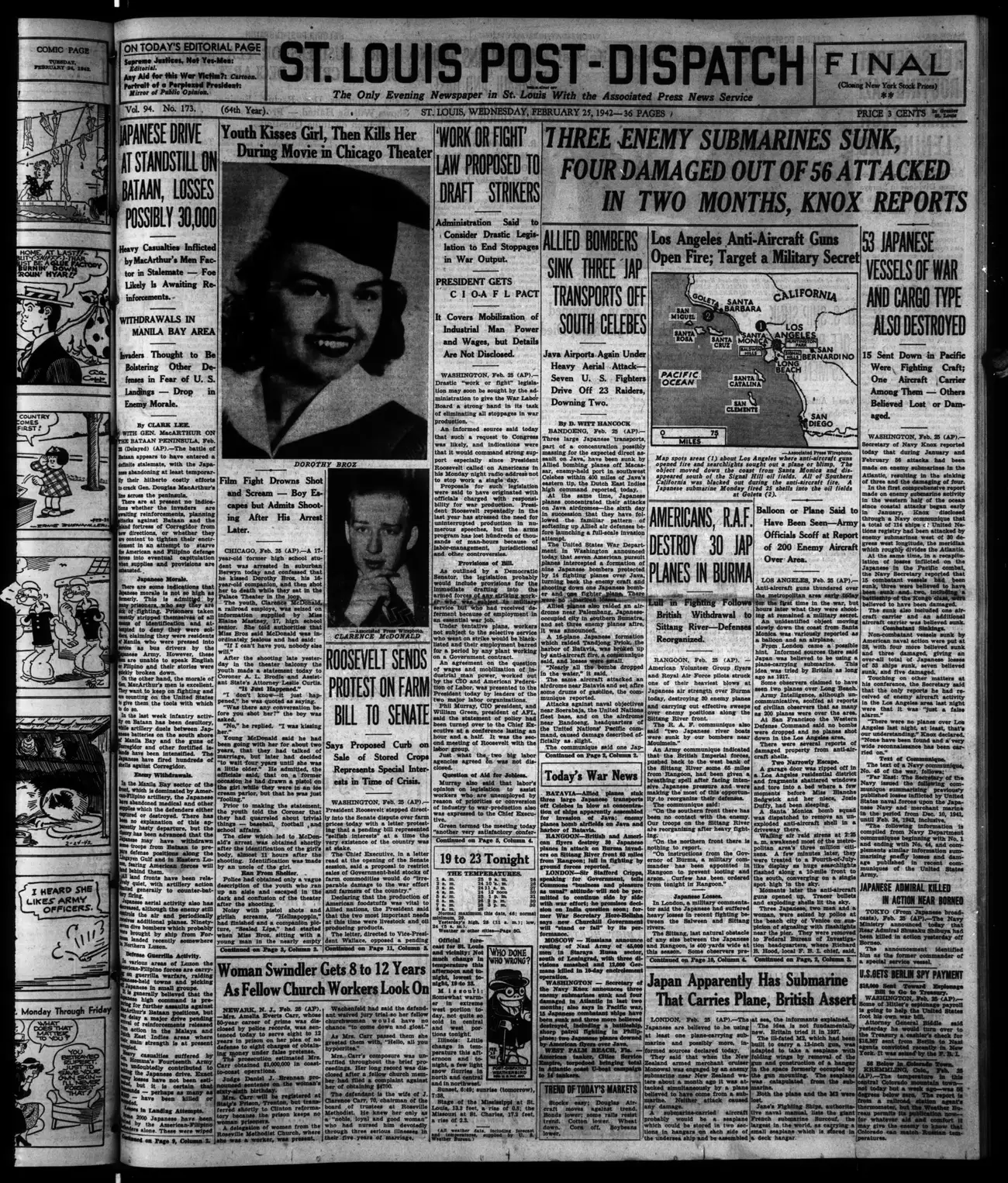
The Associated Press put the story out during the day. Evening papers across the country ran it on the front page5,6,7. The Hope Star, in Arkansas, headlined across the whole page: "Unidentified Craft Over Los Angeles, No Bombs Fall"5. The St. Louis Post-Dispatch ran "Los Angeles Anti-Aircraft Guns Open Fire; Target a Military Secret", with an Associated Press map6.
The wire story was cautious: "Anti-aircraft guns fired round after round of ammunition and tracer bullets at an unidentified object which moved slowly down the coast from Santa Monica and disappeared south of the rich Signal Hill oil fields." The Army declined to comment, and some suspected an enemy blimp5,7. The Western Defense Command said only one thing: no bombs had fallen and no planes had been shot down6.
The Navy says "false alarm", the Army says "planes"
The two departments contradicted each other in public.
On February 25, Navy Secretary Frank Knox told a press conference it had been a false alarm1,8,9. The same day, the Western Defense Command, which commanded the defence of the West Coast, warned Washington that "most previous reports had been greatly exaggerated". The Fourth Air Force believed no planes had flown over the city1.
The Army did not publish these first conclusions. It questioned witnesses, and local commanders concluded that between one and five unidentified planes had been there after all1. On February 26, Chief of Staff George C. Marshall wrote to the president2:
- unidentified airplanes, other than American Army or Navy planes, were "probably" over Los Angeles. The 37th Brigade fired on them between 3:12 and 4:15 a.m., and "these units expended 1430 rounds of ammunition";
- as many as fifteen planes may have been involved, at speeds from "very slow" to 200 miles an hour, at 9,000 to 18,000 feet;
- no bombs, no casualties among the troops, no planes shot down, no American planes in action.
Marshall thought these could be commercial aircraft flown by enemy agents, to spread alarm, locate the anti-aircraft batteries and slow production through blackouts. In his view, the varying speeds and the lack of bombs supported this2.
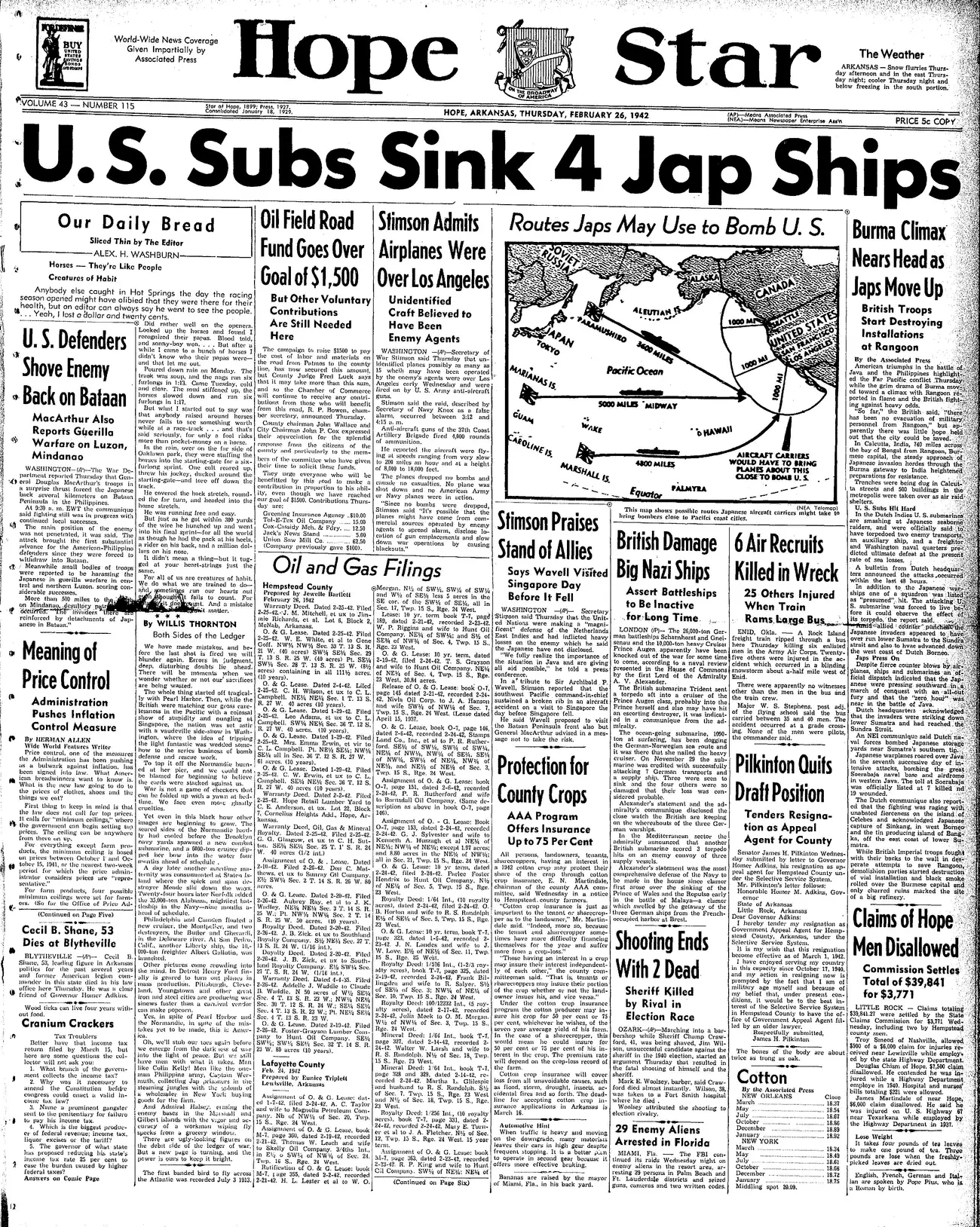
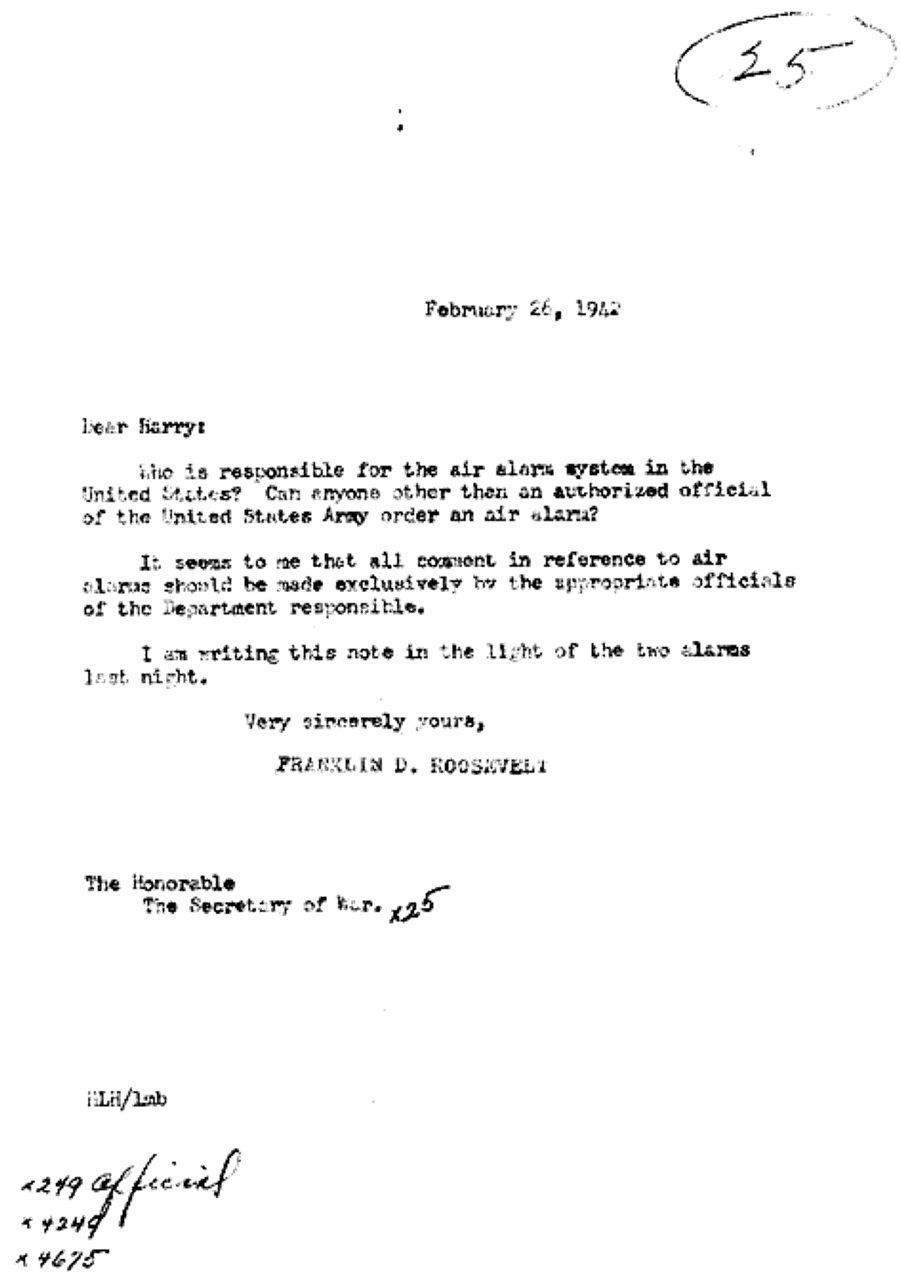
The same day, War Secretary Henry Stimson repeated these figures word for word to the press. The papers headlined the contradiction. The Hope Star ran on its front page: "Stimson Admits Airplanes Were Over Los Angeles"8,9. Roosevelt, for his part, wrote to Stimson asking who was responsible for air alarms, and who had the right to talk about them3:
"Who is responsible for the air alarm system in the United States? […] It seems to me that all comment in reference to air alarms should be made exclusively by the appropriate officials of the Department responsible."
The debate
A front-page editorial in the Los Angeles Times on February 26 demanded an explanation1. Other reactions followed1:
- in Congress, Representative Leland Ford asked whether it had been a practice raid, a raid "to throw a scare into 2,000,000 people", a mistaken identity, or a pretext to take Southern California's war industries away;
- the Washington Post called it a "recipe for jitters";
- the New York Times summed up the dilemma: "If the batteries were firing on nothing at all, as Secretary Knox implies, it is a sign of expensive incompetence and jitters. If the batteries were firing on real planes […], why were they completely ineffective? Why did no American planes go up to engage them, or even to identify them?"
The Air Force's official history would later admit that answering frankly would have revealed how weak American air defences were1.
What the inquiry found
Colonel John G. Murphy, the Fourth Army's anti-aircraft officer, watched the night from the roof of his hotel: "A beautiful picture—a grand show! But at what were they firing? […] cold detachment disclosed no planes of any type in the sky—friendly or enemy"4. He then sat on the board of inquiry, which heard about sixty witnesses, civilian and military4. Its findings:
- The witnesses were split. "Roughly about half the witnesses were sure they saw planes in the sky," the other half saw nothing. One flier described ten planes in a V formation. On the same rangefinder, the elevation operator saw many planes and the azimuth operator none4.
- The order to fire was unauthorised. It was given by the young Air Force controller on duty in the operations room, who had no authority to do so. Someone had reported a "balloon". He pictured a German or Japanese zeppelin, and no one could talk him out of it4.
- A weather balloon started it all. An anti-aircraft regiment had sent up a meteorological balloon at about 1 a.m.: "That was the balloon that started all the shooting!" Once things had calmed down, another regiment sent up a second one to correct its fire, "and hell broke loose again". Both balloons, Murphy recalls, "floated away majestically and safely"4.
Murphy concludes: "Once the firing started, imagination created all kinds of targets in the sky and everyone joined in"4.
The Air Force's official history points the same way1. Anti-aircraft units were criticised for wasting ammunition on targets too slow to be planes. The acting commander of the anti-aircraft brigade was at first convinced he had seen fifteen planes, before realising he was seeing smoke. Two war correspondents on the scene, Ernie Pyle and Bill Henry, never made out an aircraft. Finally, after the war, the Japanese stated that they had sent no planes over the area that night. Submarine I-17 did, however, normally carry a seaplane1.
The photo that became a "UFO"
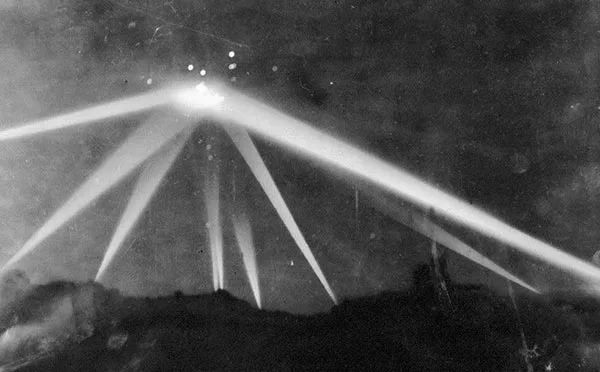
On February 26, 1942, the Los Angeles Times ran a front-page photo of searchlights converging on one point in the sky. Its caption identified the small spots of light as shell bursts lit up by the searchlights10. Decades later the photo was circulating in UFO circles as proof of a large craft that had withstood the gunfire.
In 2011, the journalist Larry Harnisch traced the history of the image in the paper's archives, held at UCLA11:
- the published version had been heavily retouched, like most press photos of the time: on the copy negative, the blacked-out skyline is painted in;
- a second, unretouched negative shows only converging beams and a few scattered spots of light.
The same year, the trailer for the film Battle: Los Angeles presented fake newspaper headlines as period documents. Harnisch compared them with the real ones: the Times front page of February 26, 1942 read "Army Says Alarm Real"10.
Errors in circulation
- The deaths. The five victims did not die "during the shooting": three were killed in road accidents during the blackout and two died of heart attacks10,6.
- The number of shells. The official figure is 1,430 according to Marshall and Stimson, and 1,440 according to the Air Force history2,9,1. The "4,000" in one wire story printed by the Hope Star is an isolated error: the other papers that day printed 1,4308,9.
- The date of the official history. It is not "from 1983": written in 1948, it was reissued in 19831.
- Murphy's date. He places the night on "February 26", when it was the night of February 24-254.
- The mix-up with Washington. The Washington, D.C. case of July 1952 is a different story: radar returns over the capital and fighters sent up in vain, without a single gun fired. The anti-aircraft fire is Los Angeles, 1942.
What remains
The episode became part of the city's memory. The Fort MacArthur Museum, at the entrance to the Port of Los Angeles, commemorates it every February12. It also inspired Steven Spielberg's comedy 1941 (1979)10.
On the substance, the documents agree. A city on edge, two days after the shelling of Ellwood. A weather balloon taken for an enemy aircraft, an order to fire given without authority. Then more than an hour of gunfire, during which shell bursts and smoke fed fresh reports. No bombs, no wreckage, no Japanese admission: nothing shows that any aircraft flew over Los Angeles that night1,4.
Case documents
The original documents: shown here when they are free to reuse, otherwise available from their holder.
Contemporary press
The Hope Star front page, February 25, 1942
"Unidentified Craft Over Los Angeles, No Bombs Fall"; column "Sources Believe Craft Was an Enemy Blimp" and a map of the Ellwood attack
Hope Star, domaine public (droits non renouvelés), numérisation Internet Archive
Contemporary press
The St. Louis Post-Dispatch front page, February 25, 1942
"Los Angeles Anti-Aircraft Guns Open Fire; Target a Military Secret", with the Associated Press map
St. Louis Post-Dispatch, domaine public (droits non renouvelés), numérisation Internet Archive
Contemporary press
The Hope Star front page, February 26, 1942
"Stimson Admits Airplanes Were Over Los Angeles" (with an erroneous "4,000" for the number of shells)
Hope Star, domaine public (droits non renouvelés), numérisation Internet Archive
Correspondence
Roosevelt's letter to War Secretary Stimson, February 26, 1942
"Who is responsible for the air alarm system in the United States?"
Photo
Searchlights over Los Angeles, February 25, 1942
The retouched version distributed to the press in 1942; the spots of light are shell bursts lit up by the searchlights
Associated Press, domaine public (droits non renouvelés), via Wikimedia Commons
Sources
- 1.Official documentWesley Frank Craven et James Lea Cate (dir.), Office of Air Force History, 1948, réédité en 1983, The Army Air Forces in World War II, vol. 1, chap. 8 « Air Defense of the Western Hemisphere », pp. 277-286 — full text on HyperWar
- 2.Official documentGénéral George C. Marshall, chef d'état-major de l'Armée, 26 février 1942, Memorandum for the President (alerte aérienne de Los Angeles) — LUFORU transcription, facsimile on Wikimedia Commons
- 3.Official documentFranklin D. Roosevelt, 26 février 1942, Lettre au secrétaire à la Guerre (« Dear Harry ») — facsimile
- 4.WitnessCol. John G. Murphy, Antiaircraft Journal, vol. 92 n° 3, pp. 4-5, mai-juin 1949, Activities of the Ninth Army AAA – L.A. « Attacked »
- 5.PressHope Star (Hope, Arkansas), dépêche AP, 25 février 1942, « Unidentified Craft Over Los Angeles, No Bombs Fall »
- 6.PressSt. Louis Post-Dispatch, dépêches AP, pp. 1 et 10, 25 février 1942, « Los Angeles Anti-Aircraft Guns Open Fire; Target a Military Secret »
- 7.PressGettysburg Times, dépêche AP, 25 février 1942, « Plane Or Blimp Is Spotted Over West Coast Early Today »
- 8.PressHope Star, dépêche AP, 26 février 1942, « Stimson Admits Airplanes Were Over Los Angeles »
- 9.PressGettysburg Times, 26 février 1942, Déclaration de Stimson, dépêche AP (« fired 1,430 rounds ») — same text in the Kingston Daily Freeman, Salem News, Sedalia Democrat
- 10.AnalysisLarry Harnisch, Los Angeles Times (blog The Daily Mirror), 21 février 2011, Another Good Story Ruined – The Battle of Los Angeles — archived copy; reproduces the Times front pages of 1942
- 11.AnalysisLarry Harnisch, Los Angeles Times (blog The Daily Mirror), 13 mars 2011, Another Good Story Ruined: Saucers Over L.A.! – Part 7 — archived copy; the negatives held at UCLA
- 12.OverviewWikipedia, consulté le 17 octobre 2026, Battle of Los Angeles
Case file written by SkyUnknown from the numbered sources below: every statement points to its own. Quotations are short and attributed; documents remain with their authors. Spotted an error, or a source we should add? Write to us