At a glance
- When: Thursday, July 1, 1965, at around 5:45 a.m.3.
- Where: a field of young lavender plants in the Olivol district, on the plateau about 2 km north-west of the village of Valensole, in the Basses-Alpes (today Alpes-de-Haute-Provence)4.
- Who: a single witness, Maurice Masse, 41, a farmer, married with two children3,6. His name has been public since July 3, 1965. He died in 200417.
- What: a craft shaped like a "rugby ball" standing on six legs and a central pivot, occupants about one metre tall, and a trace on the ground3,5.
- Official documents: three gendarmerie reports, released by GEIPAN in 20152.
- GEIPAN classification: D, but "by default, to make searches easier for Internet users". There was never an official investigation1,2.
What he told the gendarmes on July 2
The Valensole gendarmerie heard about the case "through public rumour" on Friday, July 2, at around 7:30 p.m. It called in the witness and took down his statement at 8 p.m. This is report No. 4453.
That morning, he said, he left home at about 5:30 and reached his field at about 5:40. He added that he had eaten and drunk nothing before leaving3. He was hoeing his lavender, then stopped at around 5:45 to take off his jacket and smoke a cigarette, sitting behind a pile of stones. "A moment later, I heard a whistling sound not far from me"3.
He walked towards the sound and saw "that a craft had landed in my lavender field. It was the size of a 'DAUPHINE' car and of a matt colour. Its shape looked like a rugby ball, with a sliding door on the side. The top was made of a transparent material through which I saw a person inside"3.
A second figure was already on the ground: "dressed in an overall, it seemed, bare-headed, empty-handed. I was about sixty metres away. This figure was about one metre tall, but quite stout"3. He assumed the passenger warned the one outside, who climbed straight back in. There was a "dull noise", and the craft disappeared "almost immediately in the direction of MANOSQUE"3. While at rest, it seemed to him to stand "on six legs underneath and a steel-coloured pivot in the centre". He saw "no porthole; only a sliding door"3. He added: "I cannot say what colour the figures' skin was, but I think they were of European type. I did not say so before, being afraid of trouble"3.
The gendarmes noted that "there is no other eyewitness"3. At 10 p.m. the commander of the Digne company and the head of the investigation unit arrived, and they all went to the field with the witness. They found that "a hole does indeed appear in the ground", but no other trace, "the ground having been trampled by many onlookers before our arrival"3.
Questioned again from 11:15 to 11:30 p.m., the witness added several details3:
- The craft left at an angle, and he lost sight of it after about ten metres, "quicker than lightning".
- On take-off, the six legs, "which made the craft look like a spider", seemed to turn, and the pivot driven into the ground seemed to give the "first impulse".
- At first "shaken", he only went to the spot fifteen to twenty minutes later. The earth there was "soaked".
- Coming back in the evening at around 8:30 with his daughter, he found it "hard as cement".
- He had told a friend about it the next morning, "who probably spread the news".
See the document: Report No. 445: the witness's first statement (July 2, 1965) — Valensole gendarmerie. Summary message p. 1, statement and follow-up pp. 2-4 (in French) (GEIPAN / CNES, droits réservés)
The trace recorded by the gendarmerie
The captain commanding the company and the investigation unit drew up a second report, No. 105. It records their findings on the evening of July 2 and at 8:30 a.m. on July 3, with a 1:500 sketch and eight photographs4.
In a field "whose soil was loose and freshly hoed", they found "an unusual and more recent trace"4:
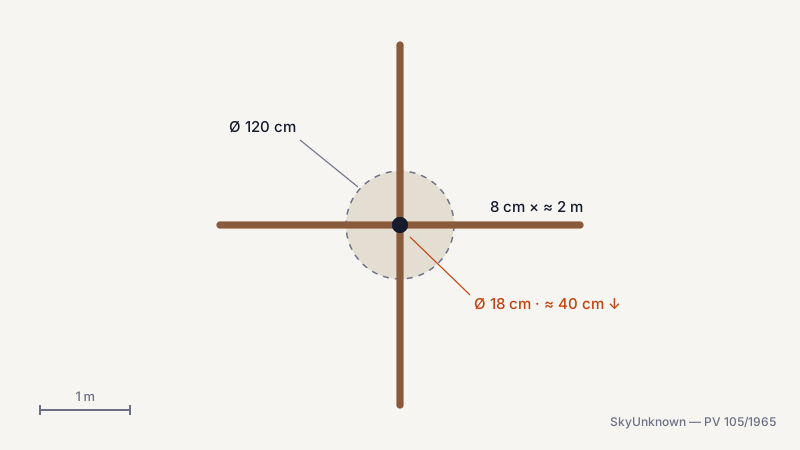
- a shallow hollow about 1.20 m across;
- in its centre, a cylindrical hole 18 cm across and "about forty centimetres deep";
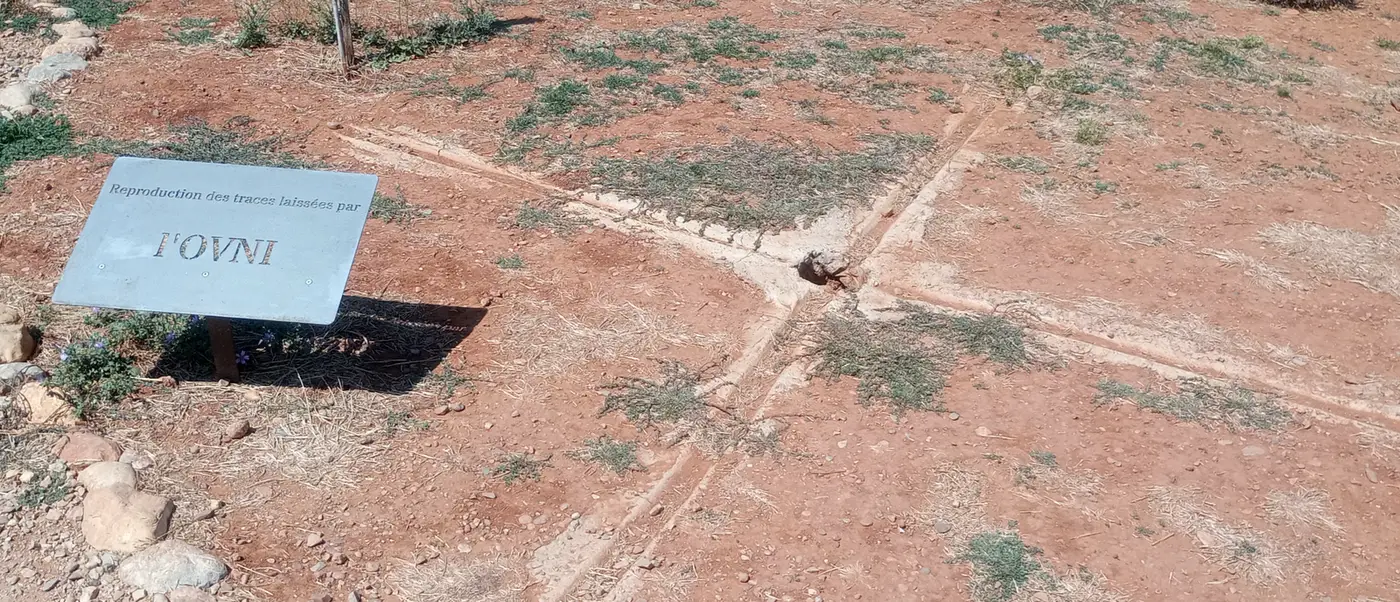
- four shallow furrows, 8 cm wide and about 2 m long each, forming "a kind of cross" around the hole;
- earth that was "compact" at this spot, while it was loose all around.
The next day they found the earth there "still compact" and the "measurements and description given earlier were accurate"4.
The report locates the trace precisely:
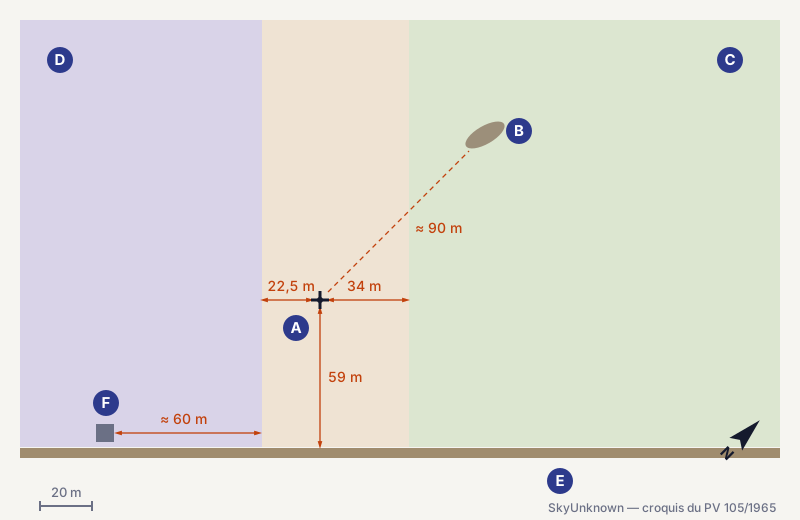
- 22.50 m from a field of old lavender, 34 m from a vineyard and 59 m from a dirt track;
- at "UTM coordinates 387 – 589 (31 TGJ)"4, which our conversion to modern GPS coordinates puts at 43.843 N, 5.969 E. That point is about forty metres from today's memorial26.
The mound of earth and stones behind which the witness said he was standing lies "about 90 m north-east of the trace". It is 8 m long and 2 m high, and from it "visibility to the trace is good". Finally: "No other clue of any kind was found in the surrounding area"4.
See the document: The gendarmerie's eight photographs: the site, the trace, the hole — Report No. 105, pages 11 to 14 (GEIPAN / CNES, droits réservés)
Three days of media storm
The story made the front page of Le Provençal on Saturday, July 36. Masse described a craft standing on four legs and a being "the size and build of an eight-year-old child". The reporter saw a hole 20 cm across and about 50 cm deep, with X-shaped marks. The earth was "as if petrified, hard as cement, while elsewhere it crumbles"6. The witness added: "immediately after the craft left, the earth had the consistency of almost liquid mud. All the stranger since it hasn't rained here for a long time"6.
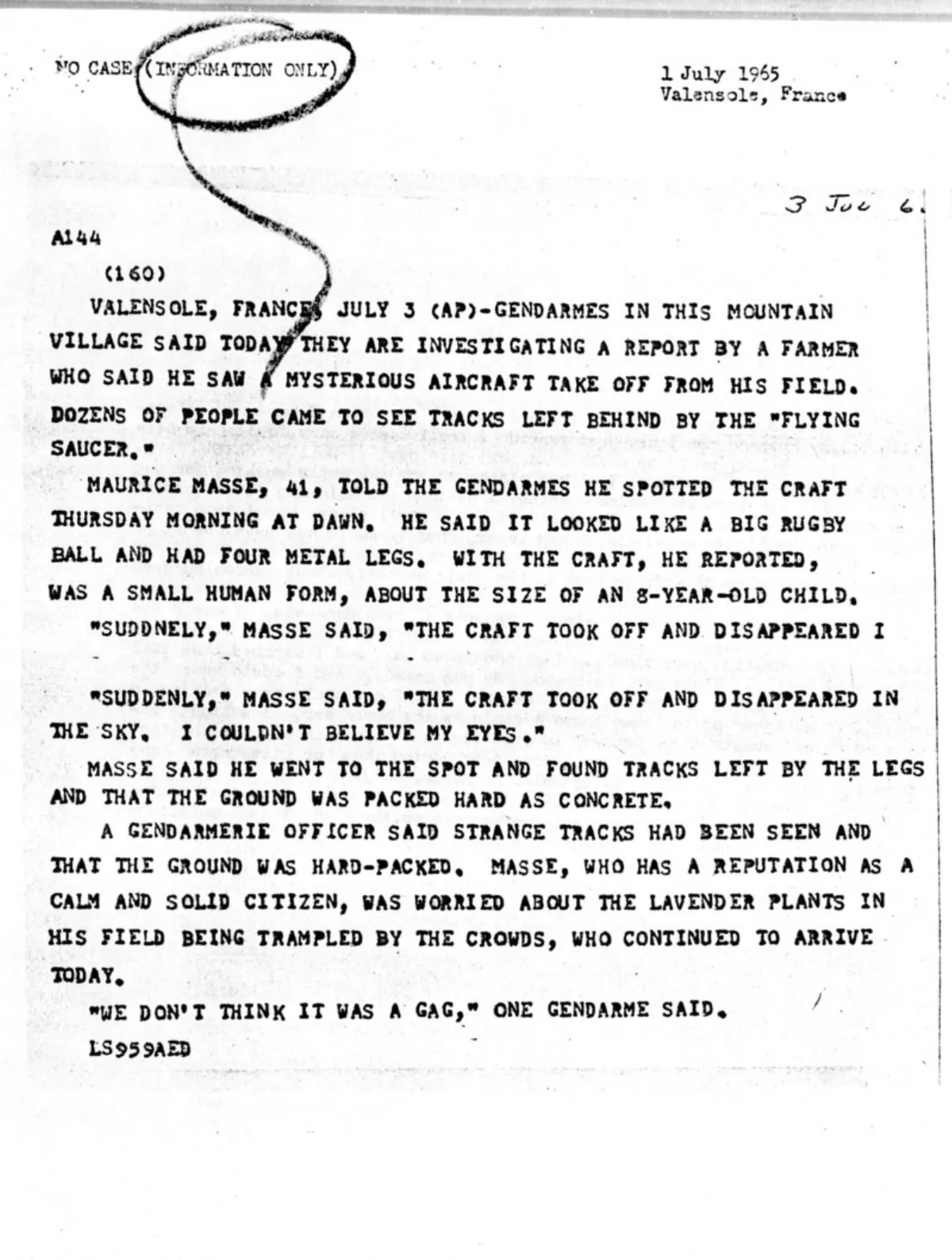
The gendarmes took it seriously. "It's strange, you really wonder what could have landed there. The marks found on the ground are very clear and very precise," they told Le Dauphiné libéré7. According to the same issue, the investigation unit took samples, and an engineer from the Marcoule nuclear centre came to the site7. The Associated Press quoted a gendarme: "We don't think it was a gag"14.
The military lead appeared at once. Since June 29, the 9th Military Region had been holding the "Provence 65" manoeuvres in the area, with army light aviation (ALAT) helicopters7. Valensole lay east of the exercise zone, but several aircraft based at Saint-Auban had taken off at the time the farmer gave7. On July 4, Le Monde ran the headline: "The flying saucer was no doubt a helicopter"10.
The witness's portrait varied from paper to paper. For Le Provençal, "Maurice Masse is well known in Valensole; he is neither a crackpot nor a prankster"8. The AFP wire story printed by Le Méridional was more guarded: known "for his easy and colourful talk, he often tells of imaginary exploits […] he is considered a good storyteller"9. The same article had him describe an "orange" suit and suggested it was the orange life jacket worn by helicopter pilots9.
On July 5, found at friends' on the Giens peninsula, Masse set the record straight11: "I clearly counted six 'legs' and a central pivot. […] The craft had neither rotor nor blades. I do claim to know a helicopter when I see one. This was not one. […] I never said it was a flying saucer."
Meanwhile the field became a place of pilgrimage. Cars came from the Var, the Bouches-du-Rhône, Paris and even Belgium12. "The size of a bottle when Mr Masse made his statement, the 'hole' is now nearly a metre deep," Var-Matin wrote on July 7. "Everyone takes away a stone or a little earth"13. The witness himself was said to be suffering "a nervous breakdown"12.
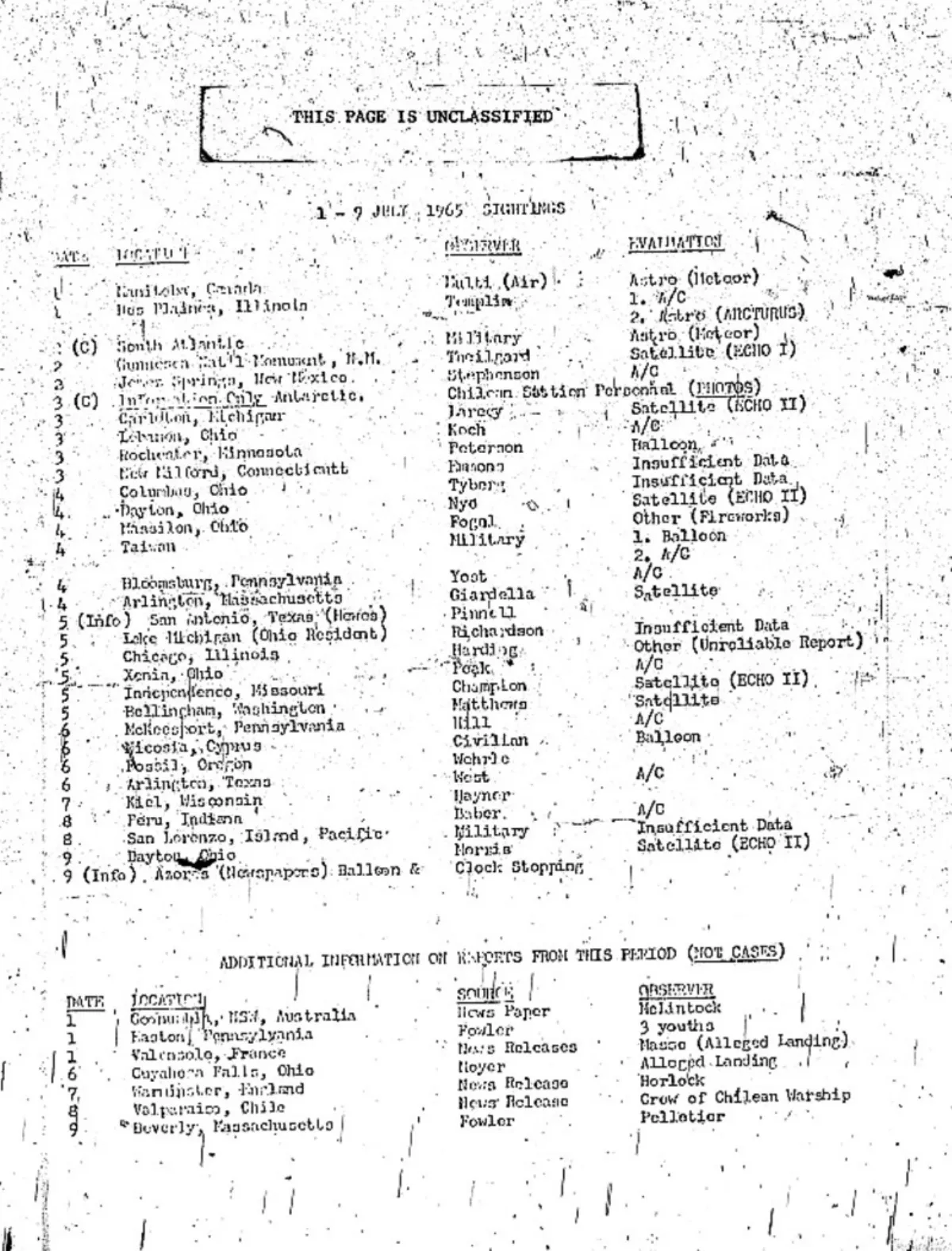
The story crossed the Atlantic. The US Air Force's Project Blue Book kept the wire stories and articles in a file. It marked the case "NO CASE (INFORMATION ONLY)", with no American investigation14.
August 18: the second version
On August 18, 1965, Maurice Masse went back to the gendarmerie on his own, saying he had "further information to give". This is report No. 1455. He explained: "When you questioned me on July 2, 1965, I did not tell you everything I had seen because it was so extraordinary that I was afraid people would think I was mad and have me locked up"5.
He now said he had actually come within "seven metres" of the craft, walking along the vineyard. The two occupants were on the ground, crouching, and "seemed to be looking at a lavender plant"5. One of them turned and made a gesture "with his right arm and hand, in which I made out an object; at that moment I was immobilised, unable to make a single movement. I felt nothing, I was neither numb nor tense"5.
His description of the two beings is precise5:
- less than a metre tall;
- a "pumpkin-shaped head three times the size of a normal man's head", hairless, with large ears and "no chin";
- "a round hole where our mouth is" and eyes like ours, without eyebrows;
- smooth skin, with a complexion close to "that of a white man";
- a "fairly dark" one-piece suit, with two holsters on a belt;
- "a kind of gurgling" coming from their throats. "They seemed to be making fun of me; their attitude did not frighten me because I did not have the feeling they meant me any harm."
After four or five minutes, they climbed back in through an opening closed by a sliding door "like a filing-cabinet door". The craft, topped by a "transparent dome as if it were plexiglass" and about 2.50 m high, rose with a dull noise. Its legs turned "clockwise", and it left at an angle "between VOLX and MANOSQUE, […] faster than a jet plane on take-off"5.
He said he stayed immobilised "for fifteen minutes", and then: "I went back to my tractor, lit a cigarette and carried on working until 7:30 or 8"5. He reported a single effect: since July 3 he had been sleeping almost twice as much as before, about ten hours instead of six or seven. "I have never taken sedatives"5.
See the document: Report No. 145: the second statement (August 18, 1965) — The two beings, the immobilisation, the take-off, the sleep (in French) (GEIPAN / CNES, droits réservés)
The private investigators
UFO researchers arrived that summer. Their reports, published in September 1965 in Phénomènes spatiaux, the bulletin of the French group GEPA, then translated in the British Flying Saucer Review, add details that are not in the police reports.
- The GEPA investigation, by a magistrate signing "G.C."15. It gives a distance of 80 m and a halt 5 or 6 metres from the beings. It credits the witness with good knowledge of army helicopters, which "frequently" landed in or near his field: he would go and chat with the pilots, "very frequently keen hunters like himself". It also says that after the paralysis he did not go back to work but went to the Café des Sports to tell the owner about the landing, then told him it was all a joke. The owner went to the field and found the marks15. Television interviewed him as early as July 196522.
- Aimé Michel adds other details16:
- a week earlier, the witness and his father had found lavender shoots broken off and taken away every morning, and Masse thought he was about to catch thieves;
- plants are said to have been damaged for about a hundred metres in the direction of take-off;
- the witness reportedly slept twelve to fifteen hours a day instead of four or five;
- according to Michel, "M. Masse has not yet dared to tell all he knows". Masse reportedly told him about the beings: "They are good. They have only good intentions towards us, of that I am sure."
- Jimmy Guieu, according to later accounts, broke the blade of his penknife trying to sample the hardened earth17.
The witness never really said more. In 1972 he reportedly told the journalist René Pacaut: "I can't say everything I saw. Nobody would believe me"17. In late 1979 he gave an interview to Jacques Vallée17. He died on May 14, 2004, without changing his story17,21.
See the document: Flying Saucer Review, Nov.-Dec. 1965: the GEPA investigation and Aimé Michel's "The Valensole Affair" — Copies kept in the Blue Book file, pages 5 to 9 (Flying Saucer Review, droits réservés)
What the authorities say
There was never an official investigation. GEPAN, the UAP office of the French space agency CNES, was only created in 1977. Its successive heads "were all interested in this case, of course", GEIPAN writes, "without publishing an in-depth investigation", which "would probably have been of little use given the time elapsed"1,2.
For the case's 50th anniversary, on June 26, 2015, GEIPAN published the three gendarmerie reports, calling them "the most reliable documents in this case"2. It also explained what its classification means: "Given its strangeness, this case is classified 'D' by default, to make searches easier for Internet users"2. In other words, the letter D is not the outcome of an investigation that ruled out every explanation. It files the case under unexplained for want of anything better.
The versions that do not match
Between July 2 and August 18, the story changed a great deal. The private investigators and the press added their own variants.
| Point | According to the sources |
|---|---|
| Viewing distance | 30 m (Le Provençal, July 3), 50 m (Le Provençal, July 5), 60 m (report of July 2), 80 m (GEPA), about 90 m (gendarmerie measurement and Aimé Michel)6,11,3,15,4,16 |
| Approach | only after the craft left (July 2), to 7 m (August 18), to 5 or 6 m (GEPA)3,5,15 |
| Legs | four (press of July 3), six and a pivot (reports and press of July 5)6,3,11 |
| Occupants | a stout one-metre man "of European type" and another on board (July 2); two pumpkin-headed beings (August 18)3,5 |
| Suit | no colour given (July 2), orange (Le Méridional), "fairly dark" (August 18)3,9,5 |
| After take-off | kept working (reports of July 2 and August 18), did not go back to work and went to the café (GEPA)3,5,15 |
| Hole | about 40 cm across (July 2), 20 × 50 cm (press), 18 cm across and about 40 cm deep (gendarmerie measurement), 60 to 80 cm (GEPA), nearly a metre after the onlookers3,6,4,15,13 |
| Sleep | from 6-7 h to about 10 h (report), from 4-5 h to 12-15 h (Aimé Michel)5,16 |
| Lavender | "will never flower again" (a reporter, July 4), no difference in colour (GEPA), plants damaged over 100 m (Aimé Michel)8,15,16 |
Some differences are easy to explain. The witness's first description was given on the evening of July 2, the gendarmes measured the next morning, and visitors then dug the hole deeper. Others go to the heart of the story: the number and appearance of the occupants, how close he came, and the paralysis missing from the first report.
The explanations put forward
- An army helicopter. This was the explanation of the military and the press from July 37,10. Dominique Caudron revived it in 1990, comparing the whistle to that of an Alouette II turbine20. It runs into several problems:
- no landing was ever reported;
- Valensole was outside the exercise zone7;
- the witness said he knew these aircraft well11,15;
- it explains neither the 18 cm hole nor the furrows recorded by the gendarmerie4. Le Provençal already objected that the Alouette only has a three-wheel undercarriage11. In fact, the Alouette III stands on three wheels and the Alouette II on skids.
- An American helicopter. In 2004 the sceptic Claude Maugé reported a hypothesis he had from the physicist Yves Rocard: a US Sixth Fleet helicopter on a spying mission. The authorities would then have preferred to let people talk about a UFO. He notes that a US spy plane flew over the Pierrelatte nuclear plant two weeks later18. No document supports it.
- A fertiliser tank. Dominique Caudron also suggested that the trace came from a liquid-fertiliser tank set up by a neighbour20. We were unable to consult his article.
- Lightning and a tall story. The collector Raoul Robé suggests that Masse found a lightning mark, then built a story for his friends at the café19. The film director Dominique Filhol, who consulted a lightning specialist, says there was no storm that day21.
- A comic book. Raoul Robé also points to "Passagers de soucoupes volantes", an illustrated story published in 1955 and reprinted in 1960, set in Provence. It features bald pilots and a paralysing ray19. Gilles Fernandez, who published the hypothesis, concluded after reading the whole story that the scenario is "unlikely (of course, not impossible)": too few similarities, too many differences19.
- A real encounter. For GEPA and Aimé Michel, the witness's sincerity, the trace and his sleep problems point to a visit from elsewhere15,16. The witness, the gendarmerie and the village described a serious man7,8,15. But the case rests on him alone.
Errors in circulation
Sixty years of retellings have distorted the case. The following points are wrong or unsourced:
- The time. The sighting did not take place at 5:45 p.m.25: it was 5:45 a.m.3.
- The beings' faces. They did not have "pointed chins"25: the witness said they had "no chin"5.
- After the paralysis. According to both his statements, he did not run to the village in a panic25: he carried on working3,5.
- The CNES investigation. GEIPAN did not investigate in 197721: it says itself that it never published an investigation1,2.
- The date of his death. Maurice Masse died in 2004, not in 201424,17.
- Calcium. Some say the soil had too much calcium, others too little20,24. No laboratory analysis has ever been published: neither the gendarmerie nor GEIPAN has made any results public.
- The classification. The case is filed as "unexplained" by default, not at the end of an investigation2.
What remains
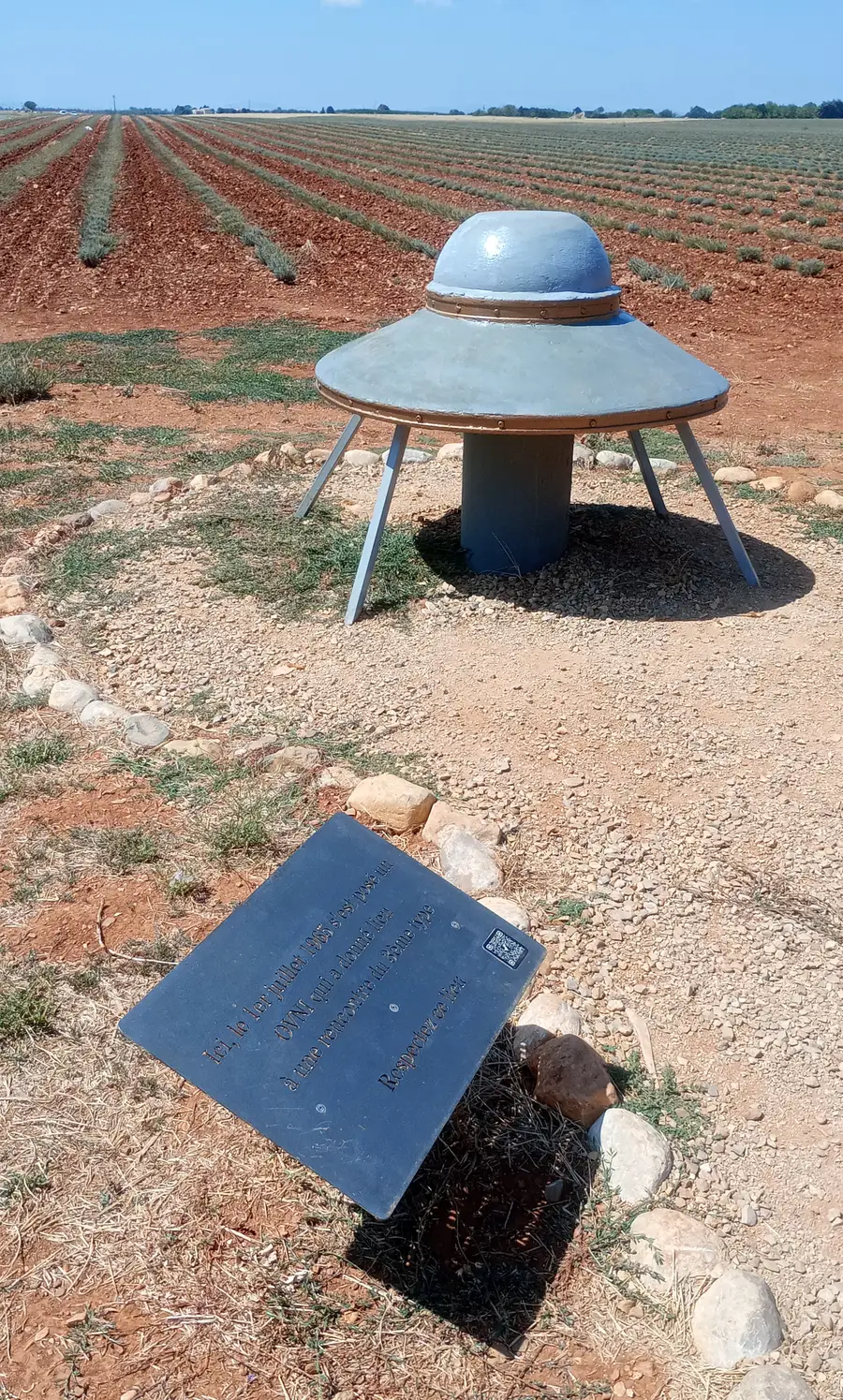
The Olivol field now has a small memorial, maintained by a village association. It has a stylised saucer, a reproduction of the trace and a plaque: "Here, on July 1, 1965, a UFO landed, giving rise to a close encounter of the third kind. Please respect this place"26. In 2015 the village marked the 50th anniversary with an exhibition23. The film Valensole 1965, by Dominique Filhol, came out in July 202521.
The established facts fit in a few lines:
- a single witness, described as sober by the gendarmerie and the village;
- a fresh trace, measured and photographed by the gendarmes the next day;
- two statements that do not describe the same scene.
Nothing has identified what left the trace, nor shown that the story was invented. The original reports are online on GEIPAN's website, and the documents below let you read them for yourself.
Case documents
The original documents: shown here when they are free to reuse, otherwise available from their holder.
Report
Report No. 445: the witness's first statement (July 2, 1965)
Valensole gendarmerie. Summary message p. 1, statement and follow-up pp. 2-4 (in French)
Protected document: available from its holder, not reproduced here.
Sketch
The site plan drawn by the gendarmerie
A: the trace. B: the stone mound from which the witness says he saw the craft. C: the vineyard. D: the old lavender. E: the dirt track. F: the hut. North is shown as on the original sketch
Photo
The gendarmerie's eight photographs: the site, the trace, the hole
Report No. 105, pages 11 to 14
Protected document: available from its holder, not reproduced here.
Report
Report No. 105: the findings (July 2-5, 1965)
Investigation unit. Measurements of the trace, location, 1:500 sketch (in French)
Protected document: available from its holder, not reproduced here.
Report
Report No. 145: the second statement (August 18, 1965)
The two beings, the immobilisation, the take-off, the sleep (in French)
Protected document: available from its holder, not reproduced here.
Contemporary press
The Blue Book file: the AP wire of July 3, 1965
"NO CASE (INFORMATION ONLY)": the US Air Force filed the story without investigating
Report
The Blue Book index for July 1-9, 1965
Valensole is listed under "Additional information (not cases)": "Masse (Alleged Landing)"
Analysis
Flying Saucer Review, Nov.-Dec. 1965: the GEPA investigation and Aimé Michel's "The Valensole Affair"
Copies kept in the Blue Book file, pages 5 to 9
Protected document: available from its holder, not reproduced here.
Report
GEIPAN's note for the case's 50th anniversary (June 26, 2015)
"classified 'D' by default, to make searches easier for Internet users" (in French)
Protected document: available from its holder, not reproduced here.
Photo
The Olivol memorial today
A stylised saucer and the "Please respect this place" plaque at the edge of the field (August 2026)
Photo
The reproduction of the trace at the site
A four-armed cross around a central hole, as in report No. 105 (August 2026)
Sources
- 1.Official documentGEIPAN / CNES, mise à jour du 23 juin 2021, Fiche du cas Valensole (04) 01.07.1965, n° 1965-07-00050
- 2.Official documentGEIPAN / CNES, 26 juin 2015, L'observation de Valensole 1965, cinquante ans après…
- 3.Official documentGendarmerie nationale, brigade de Valensole, 2-5 juillet 1965, Message de synthèse et procès-verbal n° 445 (audition du témoin) — pages 1 to 4 of the PDF, names redacted, in French
- 4.Official documentGendarmerie nationale, brigade de recherches des Basses-Alpes, 2-5 juillet 1965, Procès-verbal n° 105 (constatations, croquis, photographies) — pages 5 to 14 of the PDF, in French
- 5.Official documentGendarmerie nationale, brigade de recherches des Basses-Alpes, 18-23 août 1965, Procès-verbal n° 145 (deuxième audition du témoin) — pages 15 to 18 of the PDF, in French
- 6.PressVictor Nathan, Le Provençal, 3 juillet 1965, « Une “soucoupe volante” se serait-elle posée dans les Basses-Alpes ? » — transcription by Patrick Gross, in French
- 7.PressLe Dauphiné libéré, 4 juillet 1965, « Les gendarmes ont relevé d'étranges traces… » — transcription by Patrick Gross, in French
- 8.PressVictor Nathan, Le Provençal, 4 juillet 1965, « Le mystère reste entier sur la “soucoupe volante” de Valensole » — transcription by Patrick Gross, in French
- 9.PressLe Méridional (AFP), 4 juillet 1965, « La soucoupe volante de Valensole » — transcription by Patrick Gross, in French
- 10.PressLe Monde, p. 18, 4 juillet 1965, « La soucoupe volante était sans doute un hélicoptère » — transcription by Patrick Gross, in French
- 11.PressLe Provençal, 5 juillet 1965, « “Soucoupe” ? Engin inconnu ? … Mais pas un hélicoptère ! » — transcription by Patrick Gross, in French
- 12.PressLe Méridional, p. 14, 6 juillet 1965, « La “soucoupe” de Valensole : dépression nerveuse pour l'auteur du récit » — transcription by Patrick Gross, in French
- 13.PressVar-Matin République, 7 juillet 1965, « La soucoupe volante de Valensole… Les curieux affluent, M. Masse en dépression » — transcription by Patrick Gross (misdated 1954 on his page), in French
- 14.Official documentProject Blue Book, US Air Force, 1965, Dossier « 1 July 1965, Valensole, France » (dépêches AP, coupures, index) — copy of the US National Archives file hosted by NICAP
- 15.Analysis« G.C. » (G. Chautard), Phénomènes spatiaux, sept. 1965, trad. dans Flying Saucer Review, nov.-déc. 1965, « The Significant Report from France – G.E.P.A. Investigation » — copy in the Blue Book file
- 16.AnalysisAimé Michel, Flying Saucer Review, nov.-déc. 1965, « The Valensole Affair » — copy in the Blue Book file
- 17.OverviewJérôme Beau, RR0, La rencontre de Valensole — compilation; date of death from Guy Tarade, Magonie, July 21, 2004; in French
- 18.AnalysisClaude Maugé, Laboratoire de zététique (université de Nice), janvier 2004, Une approche de la « théorie réductionniste des ovnis » — archived copy, in French
- 19.AnalysisGilles Fernandez, d'après Raoul Robé, 20 novembre 2017, Maurice Masse Encounter (Valensole, 07/01/1965): Hoax inspired by a French Comic Book? — in English and French
- 20.OverviewWikipédia, consulté le 17 octobre 2026, Rencontre de Valensole — for the work of D. Caudron (1990) and P. Guérin, not consulted directly; in French
- 21.PressFutura-Sciences, 18 janvier 2026, Entre enquête et cinéma : le réalisateur de Valensole 1965 face au cas le plus célèbre d'Ovni français
- 22.PressINA, reportage télévisé de juillet 1965, Une soucoupe volante à Valensole ? — at the Café des Sports, with the café owner; in French
- 23.PressINA, 2015, Cinquantième anniversaire de l'arrivée des extraterrestres à Valensole
- 24.OverviewFutura-Sciences, 14 décembre 2022, 5 histoires extraordinaires et non résolues d'ovnis : le cas toujours « inexpliqué » de Valensole — cited for its errors; in French
- 25.OverviewPatrick Gross, Les OVNIS vus de près, Valensole, France, 1965 — summary page, cited for its errors
- 26.OverviewPampuco, Wikimedia Commons (CC BY 4.0), août 2026, Category:Site OVNI de Valensole — photos of the memorial; site coordinates used by Wikipedia
Case file written by SkyUnknown from the numbered sources below: every statement points to its own. Quotations are short and attributed; documents remain with their authors. Spotted an error, or a source we should add? Write to us